

Q&A: Getting to Know Tye Howell, Catalant’s New Managing Partner of Private Equity

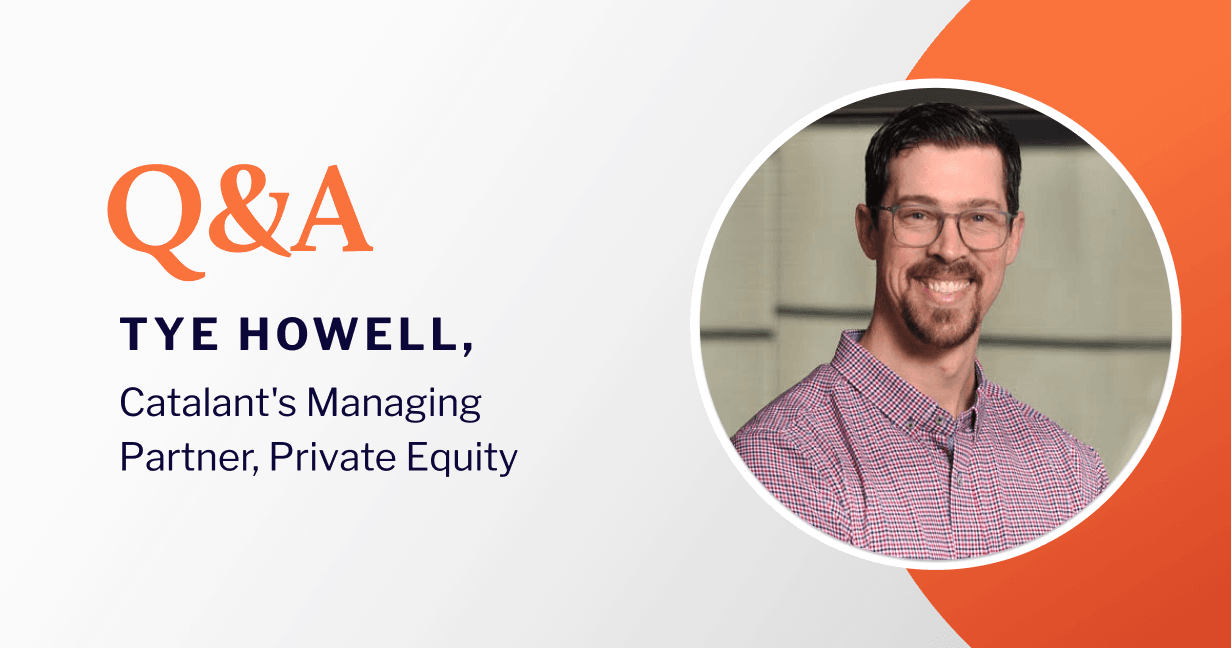
Catalant recently welcomed Tye Howell as Managing Partner of Private Equity. Tye joins after many years on the other side of the table as a private equity operating partner, board member, management consultant, and, most recently, CEO. We sat down with him to talk about why he’s decided to come to Catalant now, what’s changed in private equity, and how he thinks about Consulting 2.0.
You’ve spent your career on the investor and portfolio-company side of the table. What made now the right time to move to Catalant?
The tailwinds here are hard to ignore. Legacy consulting is being disrupted for a lot of reasons, and that’s not really a hot take at this point, it’s just where the market is. Catalant has a differentiated value proposition from legacy consulting and has grown to a place where it can offer real relevance at scale for private equity firms and their portfolio companies’ value creation efforts. The breadth and depth of our capabilities are beyond what boutiques can do but still nimble enough that clients get what they need fast; there’s no bureaucratic chain of command or administrative overhead slowing things down. That combination is what got me excited about coming to Catalant.
What lessons from your career as a private equity operating partner and, most recently, CEO shape how you approach this role?
Every one of those roles reinforced the same lesson: there’s no time to waste when you’re making changes in a business, big or small. You need to get on with it. In PE, delay elongates hold cycles. And in industry, delay generally makes change more painful. That’s the lesson I look for in every engagement now: is the team treating speed as the standard, or as a stretch goal? It’s actually a big part of why Catalant felt like the right fit. Urgency isn’t something I have to instill here, it’s built into how the model works, and my job is to make sure we hold that edge as we keep scaling. That has been a major lesson in running my own company, as well as with the dozens of portfolio companies I’ve supported over my career. Thankfully, private equity recognizes the need for that urgency right now, especially given where we are in the economic cycle, and so Catalant’s ability to quickly help them solve business problems at pace is a great benefit to the industry.
What’s changed most about how private equity firms and portfolio companies create value since you started as an operating partner?
The firms that are thriving right now have recognized we’re in a new era — money isn’t free anymore, and hold periods have stretched out further than anyone would like (GPs, LPs, and management teams). In response, the winners have put a lot of time, money, and resources into professionalizing and scaling real value creation functions. They’ve built teams of operating partners and value creation team members who’ve spent their careers driving change at scale and pace and brought them in-house to work against a discrete, measurable organic value creation plan. But those profiles are hard to find; they’re unicorns. That’s exactly why so many firms turn to Catalant. Nearly three-quarters of the top 100 private equity firms by AUM work with us to bring in seasoned consultants with real subject-matter depth who, importantly, are doers as much as they are thinkers.
What are the biggest constraints operating partners and portfolio company executives face when trying to move fast on a value creation plan?
More than anything, it’s talent and orchestration. It sounds obvious, but it bears repeating. People are stretched thin, and portfolio companies tend to run lean — there’s rarely a bench of extra people sitting around that can absorb the management and execution of incremental strategic initiatives. So even when a plan is well-defined, with clear KPIs and accessible data, the day-to-day oversight, tracking, and accountability can slip. To their credit, PE firms have recognized that gap. As such, we’ve seen a surge in demand for transformation management, integration management, and dedicated program management services. Making sure someone’s actually holding the plan accountable is one of the biggest ways we support clients and help them accelerate the delivery of the value creation plan and return of capital to LPs.
How is Catalant’s Consulting 2.0 model different from the legacy consulting model private equity firms have historically relied on?
We deliver speed and expertise, with a laser focus on driving value creation. That’s really the heart of Consulting 2.0 — we can stand up a surgical or scaled engagement with real subject-matter experts in days to weeks, not months. There’s also flexibility: bringing in one expert or seven, across multiple workstreams, through a single contractual relationship, instead of navigating four executives across three disciplines at a legacy firm. And, our consultants have driven the client’s required change before, so they know what will make a positive impact on business operations and economics. Our model also tends to provide more value to our clients, since they’re tapping directly into the expertise they need rather than engaging a large team weighted toward junior staff. But that’s really more a by-product of our differentiated offering than something we try to engineer.
Where are you seeing private equity firms and portfolio companies lean into AI right now?
Nearly all of our private equity clients are deeply leaning into AI right now in one way or another and trying to figure out the best way to turn pilots into solutions that actually deliver value. And, right now, AI in the context of discrete business function opportunities seems to be the topic we are hearing the most about. Thankfully, I think we have a genuinely differentiated, pragmatic, and proven approach to driving needed business change via AI. Through what we call Forward Deployed Experts, we pair a subject-matter expert with an engineer, so the technical execution is informed by business context. Lots of AI market offerings currently focus either on solving the technical challenge or the functional one, but few closely pair the two areas together in order to deliver a holistic solution that is purpose-fit for the client’s needs. I know a lot of folks think they can do it all with one super-resource, but we think the pairing is the unlock. It’s also a lot more efficient than spending a bunch of time hunting for unicorns.
What advice would you give an operating partner deciding whether to bring in outside expertise on a tight timeline?
Find a firm that can actually bring you the subject-matter experts you need and make sure those experts are doing the majority of the work, not just showing up for the kickoff and scoping calls. That’s rarer in this industry than people think. And it’s something Catalant does constantly, across clients, every day.
What excites you most about this next chapter?
At my core, I’m a business builder. I see a real opportunity to bring my experience to bear and compound Catalant’s efforts and successes as we continue to scale and mature. In the same way, I’m excited to keep supporting private equity through this era’s focus on organic value creation as Managing Partner of the Catalant PE team.
Operations — supply chain, procurement, manufacturing, logistics — is a major area of opportunity, especially with the disruption we’ve seen globally around tariffs. Demand for helping portfolio companies actually deliver against their plans isn’t slowing down, and that’s a great place for us to be.
Curious how Catalant’s private equity practice can help accelerate your firm’s value creation plan?
Get in TouchAbout Tye Howell
Tye Howell is a Managing Partner of Private Equity at Catalant, where he is a leader of the company’s strategy for serving private equity firms and their portfolio companies. He joins Catalant after several years as a private equity operating partner, board member and observer for multiple companies, management consultant, and, most recently, CEO. Over nearly two decades in and around the private equity industry, Tye has driven value creation at more than 40 portfolio companies, reviewed hundreds of deals, contributed to diligence on dozens, and supported seven portfolio companies through successful exits. In his role at Catalant, he works directly with operating partners, deal teams, and portfolio company leadership to help them access purpose-fit expertise and represents Catalant in the private equity community.
Private equity firms achieve organic value creation by building operating teams dedicated to executing measurable growth plans. Higher interest rates and longer holding periods require firms to professionalize operational execution. Private equity sponsors increasingly deploy specialized subject-matter experts to accelerate operational improvements and safeguard investment returns across portfolio companies.
Skill scarcity and lack of governance orchestration are primary operational bottlenecks for portfolio companies. Lean operating models prevent management teams from absorbing incremental strategic initiatives. Consequently, private equity sponsors experience high demand for program management offices, integration management, and transformation management experts to enforce accountability and protect capital returns.
The Consulting 2.0 model replaces broad, junior-heavy teams with specialized senior practitioners who execute change. This structure reduces administrative overhead, allows flexible scoping across workstreams, and aligns advisory services directly with execution speed.
Pairing technical engineers directly with domain-specific subject-matter experts ensures AI applications align with core business context. Treating AI deployment as a dual technical and functional initiative prevents pilot stagnation. This collaborative model deploys tailored solutions faster than searching for single talent profiles possessing both engineering and operational expertise.