

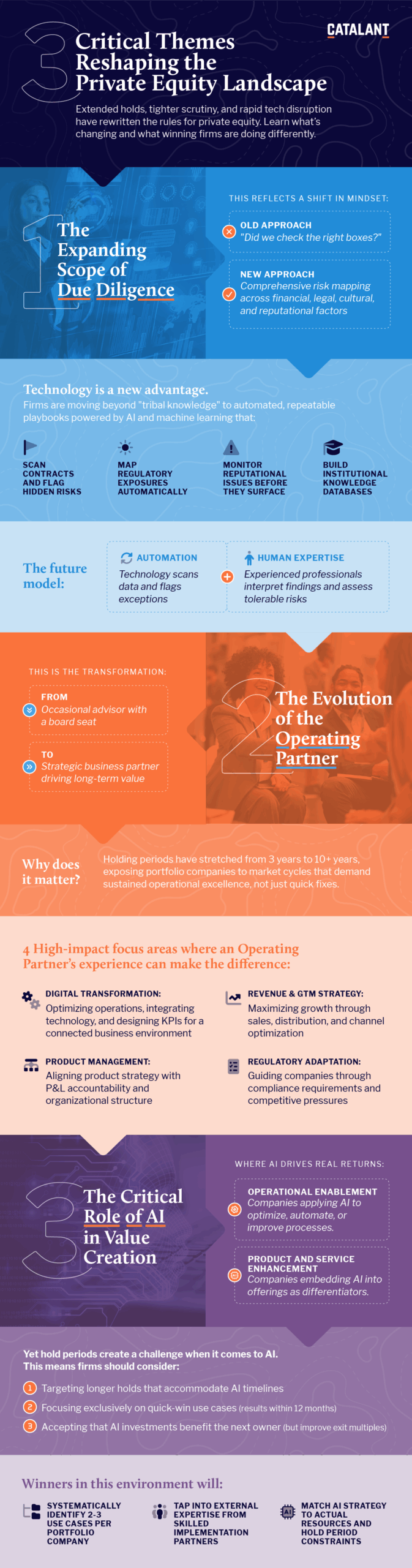
Three Major Themes Impacting the Private Equity Landscape (Infographic)


The current investment environment demands more than conventional wisdom. Fund managers face a convergence of challenges — hold periods that stretch years longer than anticipated, heightened oversight from regulators, and technology that is reshaping industries faster than portfolios can adapt.
Winning in this environment requires a different approach. Firms that succeed will be those who tap into specialized expertise, harness advanced technology to accelerate decision-making, and challenge outdated assumptions about how value gets created. The gap is widening between organizations that evolve their strategies and those that cling to methods designed for a different era.
Recently, our team launched a Private Equity Trends Report, where we interviewed seasoned Catalant consultants Charles Kaprelian, Paul Galant, and Ted Perkins, who bring decades of hands-on experience in private equity, operations, and technology transformation. Their perspectives — drawn from real deals, portfolio management, and value creation initiatives — illuminate what’s working now and what’s coming next.
Or keep scrolling for an infographic rundown of the trends and insights they shared.
Ready to Sharpen Your Investment Edge?
The PE landscape has fundamentally changed, and so has the playbook for winning. The firms that separate themselves in this environment won’t be those chasing trends or making snap judgments. They’ll be the ones that move deliberately, execute systematically, and stay focused on what actually drives measurable returns.
At Catalant, we connect private equity firms with battle-tested consultants who bring the operational depth, technical sophistication, and strategic perspective you need to navigate a complex investment landscape. From diligence to value creation to exit, our network of industry leaders helps you execute with confidence and precision.
Unlock hidden value and drive measurable results across your portfolio.
Get in TouchPrivate equity firms are replacing traditional tribal knowledge with automated, repeatable playbooks to identify hidden financial and reputational risks. Winning firms now combine AI-driven contract scanning and regulatory exposure mapping with human expertise to interpret findings. This shift from a linear checklist to an institutional knowledge database allows fund managers to assess tolerable risks more accurately during an era of heightened oversight and rapid market shifts.
The logic of private equity has shifted as holding periods stretch toward 10 years, requiring Operating Partners to drive sustained operational excellence rather than quick fixes. Long-term holds expose portfolio companies to multiple market cycles. Consequently, the Operating Partner must now act as a strategic business partner focused on four high-impact areas: digital transformation, go-to-market strategy, product management, and regulatory adaptation to maintain P&L accountability.
Firms must match AI deployment to hold periods by either targeting quick-win use cases or accepting that AI investments serve to improve exit multiples. Successful firms systematically identify two to three specific use cases per portfolio company to drive operational enablement. Because AI timelines often conflict with traditional three-year cycles, fund managers must use external implementation partners to accelerate results or shift toward longer hold models that accommodate technology adoption curves.
Institutionalizing knowledge through AI and machine learning allows firms to monitor regulatory exposures and reputational issues before those risks surface. Moving toward a technology-scanned exception model reduces the reliance on individual memory and siloed expertise. By building a unified data foundation, private equity firms can automate the detection of operational anomalies across the entire portfolio, leading to more deliberate decision-making and measurable returns during the value creation phase.
Maximizing revenue through channel optimization and aligning product strategy with organizational structure are the primary levers for increasing exit valuations. Digital transformation and GTM strategy remain critical for a connected business environment. By embedding AI into product offerings as a differentiator and optimizing end-to-end workflows, firms provide a cleaner, high-growth asset to the next owner, effectively justifying a premium price at the time of divestiture.