
The Autonomous Warehouse Advantage

Rethinking distribution for apparel, footwear, and lifestyle brands in an era of peak volatility, SKU complexity, omnichannel demand, and continuous fulfillment
Apparel, footwear, fashion accessory, and lifestyle brands operate in the most volatile distribution environment in retail. Demand swings by a factor of two to four between baseline and peak season. Assortments turn over by season, sometimes faster. Between 20 and 40 percent of everything shipped comes back as a return. Orders now arrive as single-unit direct-to-consumer (DTC) parcels, bulk wholesale pallets, buy-online-pickup-in-store (BOPIS) pickups, and ship-from-store requests, all drawn from one inventory pool. And the workforce required to absorb all of this by hand is shrinking, aging, and increasingly expensive to retain.
These are not five separate operating problems to be solved with five point solutions. They are symptoms of a single mismatch: distribution infrastructure that is fixed in capacity, layout, and staffing model, straining to serve demand, assortments, and channels that are not fixed at all. Autonomous, AI-orchestrated warehouse robotics is the industry’s emerging answer, and it is being adopted at scale by a fast-growing set of retail powerhouses.
Warehousing is Under Structural Pressure
Every distribution operator has lived some version of the same story. Order volumes hold for most of the year, then a holiday season, a promotional cycle, or a new collection drop drives demand up significantly within a matter of weeks. Meanwhile, temporary labor markets have tightened, wage rates for seasonal workers have risen, and the training time needed to bring a new hire to full productivity in a modern, system-directed fulfillment environment has grown, not shrunk.
Even outside of peak seasons, the labor pool warehouses have historically drawn from is aging and shrinking in relative terms. Supply chain and logistics operations broadly report the effects: 78 percent of facilities report significant difficulty hiring and retaining qualified warehouse staff. This is the backdrop against which every peak-season plan, every SKU expansion, and every omnichannel rollout now has to be made.
These forces converge on the same underlying weakness: distribution infrastructure that is fixed in capacity, layout, and staffing model is being asked to serve demand, assortments, and channels that are not fixed at all.
For the operators, distribution center managers, and supply chain, operations, and finance executives who own these outcomes, the pressure is no longer cyclical; it is structural. And for many organizations, the solution is robotics.
In fact, Gartner forecasts that, by 2030, half of all new warehouses built in developed markets will be designed as “robot-centric” facilities in which human labor is required only for exception handling rather than as the foundation of daily operations.
For decision-makers evaluating capital plans with multi-year horizons, that forecast is a call to act on the current planning cycle, not the next one.
Five Executive Themes for Apparel, Footwear, and Lifestyle Brands
Three forces — peak season, SKU complexity, and round-the-clock accuracy — are common to every distribution network. But apparel, footwear, and lifestyle brands carry additional structural characteristics that make the case for autonomous warehousing more compelling than a labor-savings argument alone. Let’s reframe the discussion around five executive themes, moving from tactical warehouse operations toward the strategic supply chain questions that VP of Supply Chain, COO, and CFO audiences actually use to make investment decisions.
#1: The Peak Season Challenge — Scalability and Labor Flexibility
Place distribution centers on a spectrum from fully manual to fully automated. Manual operations rely on workers using paper pick lists or handheld scanners, which drives up labor costs. Semi-automated operations blend that labor with goods-to-person conveyance and pick-to-light, still coordinated by people at the pick face. Highly automated operations layer in fixed automated storage and retrieval system (AS/RS) and high-speed sortation but within a fixed, purpose-built infrastructure. Each step up the spectrum improves throughput; each step also increases the fixed capital tied to a specific layout and a specific capacity ceiling.
Manual and semi-automated operations both scale for peak season the way they always have: by adding people. In the fixed-automation case, operations scale by running assets harder against a ceiling set at design time. Both paths run into the wall that has been described — a shrinking, more expensive, harder-to-train seasonal labor pool — and fixed automation that cannot exceed its designed throughput no matter how much volume arrives.
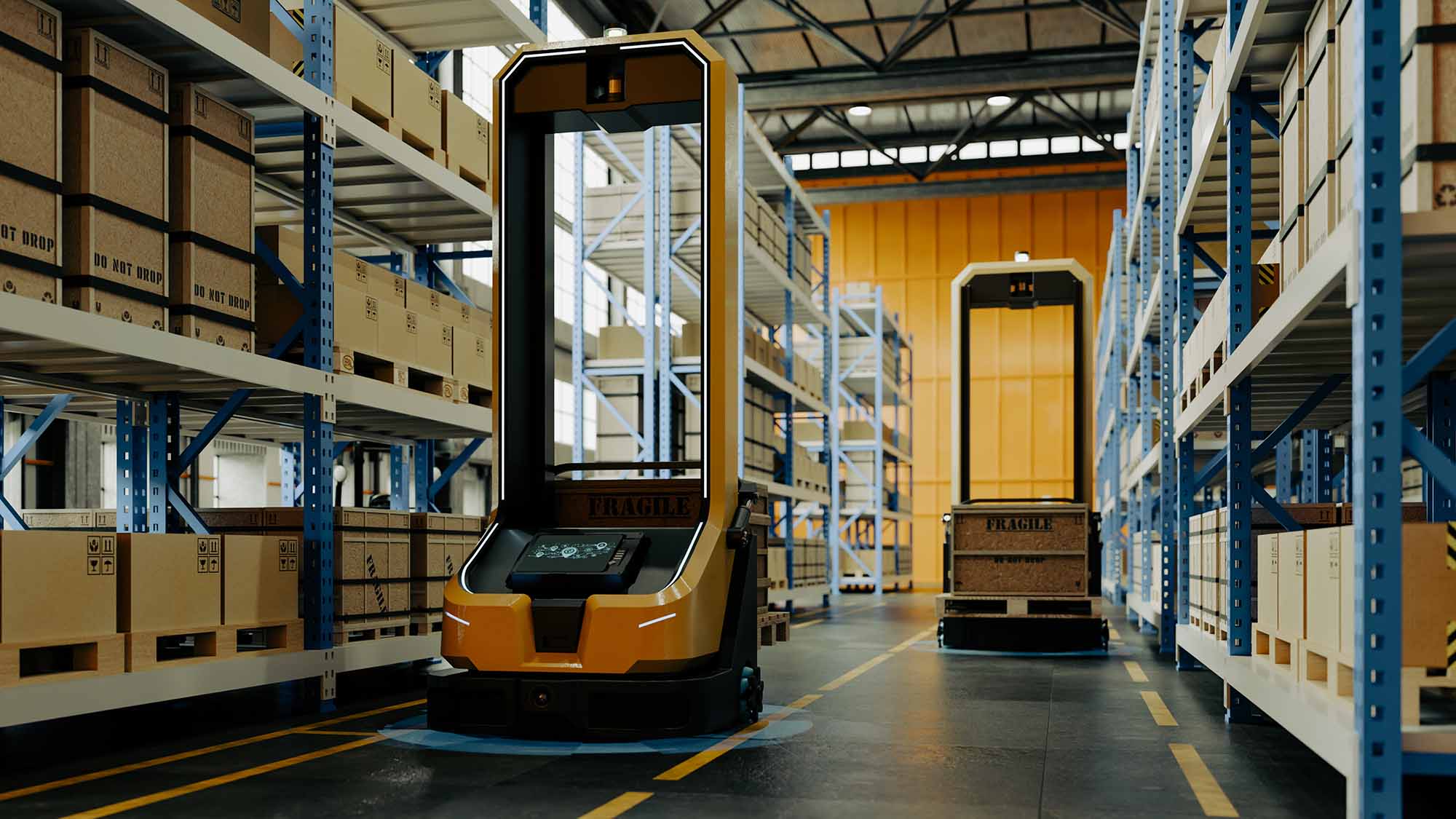
Autonomous, software-orchestrated robot fleets change the scaling mechanism itself. Because the robots are mobile, modular, and coordinated by a cloud logistics platform rather than fixed conveyance, additional units can be added to an existing footprint to absorb a volume spike, and idle capacity can be redeployed elsewhere in the network during the off-season.
Figure 1: Independent market estimates size the warehouse robotics segment on a sustained double-digit growth trajectory through the early 2030s.

Source: Fortune Business Insights
#2: SKU Proliferation and Product Lifecycle Compression
This may be the most apparel-specific challenge in the entire distribution model. Inventory in apparel is never static: every season introduces new styles, new colorways, new sizes, and new collections. As assortments broaden, primary pick faces multiply, individual items spread further apart on the floor, and travel time per pick rises regardless of how cleverly the space is organized or how much labor is applied. Fashion and apparel inventory turnover benchmarks range anywhere from 6 to 12 turns a year, with 30 to 60 days of stock on hand based on the business model, which means that a significant share of the warehouse footprint is being re-slotted on a rolling basis.
Under a traditional model, that re-slotting is a project: an engineering study, a slotting analysis, a scheduled, labor-intensive set of moves that disrupts productivity while it is underway. The inverse illustrates the cost of getting it wrong: rationalizing a catalog by even a small amount can significantly cut total inventory and improve on-time-in-full performance, evidence of how much excess cost a poorly slotted SKU count quietly adds.
Autonomous fulfillment systems are built to treat this differently. Rather than a periodic re-slotting project, an AI-orchestrated system continuously evaluates and adjusts inventory position: fast movers migrate toward the pick face automatically, slow movers are repositioned intelligently, and the system scales primarily through software and computer vision rather than square footage.
The future warehouse does not get periodically re-engineered for the new season. It continuously self-optimizes around it.
#3: Omnichannel Fulfillment and Inventory Agility
A decade ago, most apparel distribution centers existed to do one thing: replenish retail stores. Today the same four walls, and often the same inventory pool, must support direct-to-consumer e-commerce, wholesale, retail store replenishment, marketplaces, BOPIS, ship-from-store, and social commerce, simultaneously.
Under a traditional model, each of these order profiles has historically demanded a different picking methodology, a different labor model, and a different workflow. Single-unit e-commerce picking looks nothing like pallet-level wholesale replenishment, and running both well, from the same floor, with the same people, is difficult. BOPIS, in particular, has grown quickly and places outsized demands on inventory accuracy, since a retailer promising an item is ready for pickup needs that inventory to actually be there.
Robotic, AI-orchestrated systems are largely indifferent to this distinction. A general-purpose picking robot does not care whether an order calls for 1 unit or 20; the orchestration software dynamically prioritizes work across order types based on real-time demand and service-level commitments, rather than routing different order types down separate, purpose-built lines. That flexibility allows a single facility, and a single inventory pool, to serve DTC, wholesale, retail, and marketplace demand concurrently without requiring multiple parallel fulfillment strategies.
#4: Accuracy, Continuous Operations, and Service Levels
Accuracy and uptime are where the gap between manual and autonomous operations is most measurable. Manual picking carries an error rate of roughly one to three percent, compared with one percent or less for automated systems. The Association for Supply Chain Management benchmarks best-in-class order accuracy at 99.5 to 99.9 percent, a level that is difficult to sustain manually across three shifts but a reasonable goal for automated operations.
The Returns Battleground
This is the piece of apparel fulfillment most automation discussions skip entirely, and it may be the single largest apparel-specific service-level exposure. Online return rates for apparel run 20 to 40 percent, and footwear 17 to 30 percent, well above electronics (8 to 15 percent) and beauty (4 to 12 percent).
Every returned unit has to be inspected, reconditioned, re-labeled, and restocked before it can be resold. At apparel’s return volumes, this reverse flow creates real congestion, real labor spikes, and real inventory inaccuracy if it is not built into the facility design from the start. Reverse logistics costs that already run $30 to $65 per item in categories like electronics give a sense of how quickly returns processing can erode margin when it is handled as an afterthought.
Autonomous, AI-enabled facilities are increasingly built to treat returns as a first-class workflow rather than a side process: automatically routing inventory based on condition and accelerating the path back to resale-ready shelf position. In a category where a significant portion of items shipped come back, the operator who processes returns fastest wins the inventory position.
#5: The Autonomous Warehouse as a New Network Design Model
This is the most strategic of the five themes and the one most likely to change how supply chain, finance, and operations executives evaluate capital plans. Most warehouse leaders today ask, “How do I make my current building more efficient?” The more consequential question, and the one autonomous warehousing puts on the table, is, “Do I even need a building this size?”
Working Capital and Inventory Velocity
Because manual and semi-automated warehouses are labor-constrained, organizations running them tend to carry more safety stock, have larger facilities, and retain more inventory buffers to protect service levels against labor variability. Faster, more predictable, AI-orchestrated fulfillment breaks that link. Companies using AI in forecasting report improving accuracy by up to 30%. That improvement, coupled with streamlined, AI-powered fulfillment processes, enables organizations to reduce excess inventory without causing stockouts. Warehouse autonomy, in other words, is not just an operations story; it is a balance-sheet story, and that is the argument most likely to resonate with CFOs.
Space Utilization and Network Design
In a traditional facility, size is driven by labor: travel distances, pick paths, aisle widths for people and equipment, and peak staffing levels all push toward a larger physical footprint. In an autonomous facility, those labor-driven constraints largely disappear, and size becomes a function of inventory requirements and throughput requirements instead. Automated, high-density storage formats have been shown to cut required storage footprint significantly, with some solution providers like Hai Robotics claiming to reduce storage footprints by as much as 75 percent.
This changes the economics of network design well beyond a single building’s productivity. A brand planning its next distribution footprint is no longer only asking how to run its current square footage more efficiently; it is asking whether the next facility needs to be built at the same scale or whether an autonomous, high-density design can serve the same volume, and the same SKU count, from a meaningfully smaller and better-located building.
Labor Scarcity as the New Design Constraint
The issue is not only labor cost but, more importantly, labor availability. Supply chain and logistics operations report notable workforce shortages, with warehouse operations among the hardest hit. The strategic question for network planners is shifting from “How do we reduce labor cost?” to “How do we design a network that still operates when local labor simply is not available at the volume or price the old model assumed?” That is a materially stronger argument for capital investment in automation than a straightforward labor-savings pitch, because it treats automation as a resilience investment rather than a cost-cutting one.
Sustainability and ESG
Sustainability commitments are now a standing feature of apparel brand strategy, and warehouse footprint and energy consumption sit squarely inside that scope. Dense automated storage systems have been shown to reduce customer electrical usage, with individual robotic units in leading platforms drawing roughly as much power as a household appliance. Because automation shrinks the physical footprint required for a given inventory position, it proportionally reduces the building envelope that must be heated, cooled, and lit for a given volume of throughput. The most sustainable warehouse, in other words, may simply be the smaller, denser, more efficient one — the same facility that working-capital and network-design arguments already point toward.
Results Apparel and Footwear Operators are Already Reporting
A growing set of named apparel, footwear, and adjacent lifestyle-category operators have already deployed autonomous and highly automated fulfillment systems and published results. Skechers offers the clearest, most fully documented example.
Skechers USA, a global footwear and apparel company, determined that manual picking, the historical standard for its operations, could no longer keep pace with staff shortages and an expanding SKU range. The company’s new, automated facility is operated by 69 autonomous case-handling robots that navigate narrow aisles with a vertical reach of up to 32 feet, integrated with a cloud-native warehouse management system. Skechers’ own leadership credited the system with maximizing both floor-space utilization and hard-to-reach vertical storage, while delivering the productivity gains needed to support growth.
Skechers is not an isolated data point. Other apparel and footwear brands are also announcing impressive results from automation deployments:
These are production distribution centers run today at commercial scale, reporting the same pattern the themes above predict: higher throughput, lower error rates, faster training, smaller footprints, and the ability to absorb demand spikes without adding fixed capacity.
Depending on where warehouses fall on the automation spectrum, there are impactful potential gains across key operational metrics. For example, the following benchmarks demonstrate the gains companies see as they move across the automation spectrum, from manual to fully autonomous:
The Future of the Dark Warehouse
The industry describes the end state of automation as the “dark” or “lights-out” warehouse: a facility, enabled by AS/RS, autonomous mobile robots, AI, and industrial IoT, designed to operate around the clock with little or no human intervention on the floor. Full lights-out implementations remain the exception today, but the direction of travel is clear, and it carries a real estate consequence.
For an apparel, footwear, or lifestyle brand specifically, a mature dark warehouse looks different from the generic industry description. It is a facility:
- Where continuous re-slotting is not a quarterly project but a permanent, invisible background process
- Where returns flow through an automated inspection and restocking pipeline rather than a manual triage table
- Where DTC, wholesale, retail, and marketplace orders are picked from the same dense storage grid by the same fleet, prioritized in real time rather than routed down separate lines
- Where the facility itself is sized for inventory and throughput rather than for aisle widths, congestion, and shift-based staffing coverage
This is a shift from fixed, static infrastructure to software-managed environments that continuously self-optimize, rerouting robotic pickers to higher-priority orders during peak demand or reallocating tasks between people and machines as staffing levels fluctuate. Gartner offers practical guidance to supply chain executives: start by adopting digital twin and simulation models before construction; favor scalable, software-defined robotics platforms over single-purpose automation; and build long-term vendor partnerships that support future flexibility.
The dark warehouse is not a distant concept. It is the logical endpoint of trends already visible across peak season planning, SKU strategy, omnichannel design, service-level management, and network design, arriving fastest in exactly the sector, apparel and footwear, that has the most volatility to absorb.
Where the Industry is Headed
Market sizing across independent research firms is consistent in direction even where the specific figures differ: the warehouse robotics and automation market is on a sustained double-digit growth trajectory through at least 2030 and into the early 2030s (see MarketsandMarkets or Fortune Business Insights). What is changing is not only how much capacity gets automated but what kind of automation gets built.
The industry is moving away from fixed, single-purpose systems designed around a snapshot of today’s SKU count and today’s peak volume and toward general-purpose, AI-orchestrated robotics platforms designed to flex with volume, absorb SKU growth without a footprint penalty, unify omnichannel order flow, process returns as fast as they process shipments, and sustain accuracy around the clock.
For operations, finance, and supply chain leaders, the practical implication is straightforward. The pressures examined here — peak season volatility, SKU proliferation, omnichannel complexity, returns volume, and labor scarcity — are symptoms of the same underlying mismatch between fixed infrastructure and variable demand. The autonomous warehouse model, already proven in production by several industry leaders, is the industry’s emerging answer to all of them at once. This is a network design decision that apparel, footwear, and lifestyle brand leaders will increasingly be judged on making, or missing, this decade.
What’s in the future for your logistics footprint? Wherever you are on the automation spectrum, we can help you take the next step.
Get in TouchMeet the Author
Ketul Patel, a Catalant consultant and Founder and President of OMIIA Consulting, is a seasoned expert in supply chain and operations transformation with over 30 years of experience driving operational excellence, supply chain strategy, logistics planning, S&OP, tech implementations, and business turnaround across Fortune 500 retail and CPG companies. As both a hands-on operator and strategic thinker with experience at leading corporations and consulting firms, Ketul serves as a trusted advisor to C-suite executives. Ketul has a Master of Science in Industrial Engineering from the University of Houston and a Bachelor of Engineering. Ketul is also the author of “A Journey of Elevation: Lessons for Business Transformation from Everest Base Camp,” a compelling blend of personal adventure and leadership insight.
Autonomous warehousing shifts the peak season scaling mechanism from adding physical labor to deploying mobile software-orchestrated robotics. Traditional manual and fixed-automation distribution centers hit operational ceilings during volume spikes due to labor shortages and fixed conveyance limits. AI-orchestrated autonomous mobile robots allow operators to scale throughput by adding units to existing footprints, eliminating seasonal hiring bottlenecks and capital-intensive infrastructure constraints.
Continuous AI-driven re-slotting replaces labor-intensive engineering projects with automated real-time inventory placement. Industry benchmarks highlight that apparel catalog turnover requires frequent re-slotting, which traditional warehouses execute via disruptive manual moves. Autonomous fulfillment platforms use computer vision and software algorithms to dynamically move fast-moving items closer to picking faces, reducing travel time and footprint requirements without interrupting daily distribution operations.
Autonomous warehousing lowers working capital demands by increasing fulfillment predictability and reducing safety stock requirements. Manual fulfillment risks labor variability, driving supply chain executives to hold larger inventory buffers and lease larger real estate footprints. AI-orchestrated robotics achieve order picking accuracy above 99.5%, enabling retail enterprises to reduce excess inventory levels, compress physical storage footprints by up to 75%, and improve overall balance sheet efficiency.
Autonomous fulfillment platforms convert reverse logistics from an operational cost sink into an automated, streamlined inventory recovery pipeline. Apparel e-commerce experience return rates between 20% and 40%, creating severe warehouse congestion and margin erosion. AI-orchestrated robotic systems integrate returns as a core workflow, automatically sorting, inspecting, and restocking returned merchandise to accelerate the timeline back to resale-ready inventory positions.
Supply chain leaders must treat labor availability as a foundational network design constraint rather than a simple cost-reduction opportunity. Industry metrics indicate that 78% of logistics facilities face severe recruiting and retention challenges. Designing high-density, robot-centric facilities allows enterprises to build operational resilience, ensuring continuous, 24/7 fulfillment capabilities in regions where manual warehouse labor is scarce or cost-prohibitive.