
From Visibility to Autonomy: Climbing the AI Maturity Curve in Logistics


A staggering number of trucks on the road today still run on physical paperwork. They’re using paper bills of lading, proof-of-delivery slips, and handwritten notes passed between drivers and dispatchers. Logistics is one of the least digitized major sectors in the economy, and it’s colliding head-on with one of the fastest-moving technologies in a generation: AI.
AI’s impact on logistics isn’t uniform. It depends heavily on where a company sits in the network. Third-party logistics companies (3PLs) sell visibility and service, so AI shows up first in control towers and customer-facing exception management. Shippers focus on optimizing spend and network design, so AI is emerging in procurement and transportation planning. Carriers manage physical assets and compliance, so AI is changing fleet maintenance and driver safety.
But company type only explains where AI shows up first. It doesn’t explain how advanced that AI actually is.
Two companies can both claim to be using AI in logistics and sit a full stage apart in maturity. One might have a predictive, coordinated system, while the other has a chatbot bolted onto a legacy dashboard.
Most conversations about AI in logistics lean too heavily on hype. They treat every new tool as equally transformative. But leaders should be asking what stage of maturity — visibility, automation, orchestration, or autonomy — these new tools represent, not just whether or not the tools use AI.
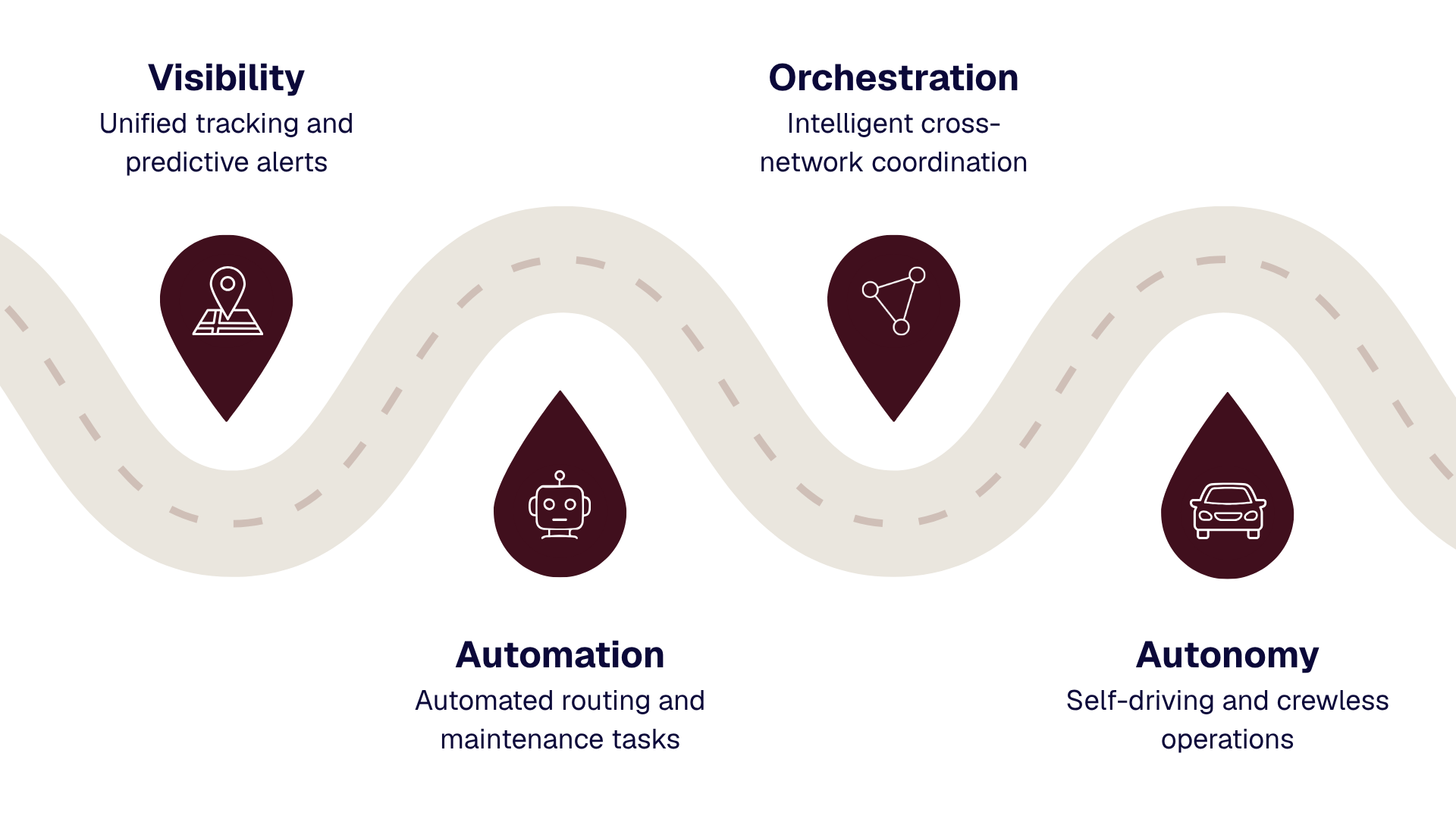
There is a real cost to investing in orchestration tools before an automation foundation can support those tools or chasing autonomy headlines while leaving proven, lower-stage wins on the table. Diagnosing where your organization sits on that maturity curve, function by function, is what turns AI spending into a realistic, strategic plan instead of a collection of point solutions.
Stage One: Actionable Visibility
The first stage of the AI maturity curve in logistics is about delivering actionable intelligence at the right time.
Building visibility is a bigger undertaking than it appears. Getting to a single source of truth requires harmonizing data sources that were never designed to talk to each other. Often, data lives in inconsistent formats across dozens of counterparties and quality varies wildly depending on partner size and sophistication. Teams need to build a foundation that reconciles conflicting information so that it can be trusted for decisions downstream.
With that foundational data in place, AI can layer on top of it to sharpen visibility and help teams make better decisions in real time.
Predictive ETA illustrates this shift. Instead of monitoring static GPS coordinates, advanced engines ingest real-time traffic, weather, historical dwell times, and carrier exceptions to calculate risk before delays cascade. A red/yellow/green flagging structure lets teams manage by exception rather than forcing them to react to every shipment individually.
AI is also helping companies collect and organize the raw data that visibility depends on. AI-powered optical character recognition (OCR) tools can capture even handwritten carrier notes and convert them into usable digital records, chipping away at one of the industry’s oldest bottlenecks.
Once that data is flowing reliably and teams can trust what they’re seeing, the natural next step is to let AI start acting on it directly.
Stage Two: Task-Level Automation
In the automation stage, AI is capable of handling defined tasks from end to end. This is far more sophisticated than just surfacing information.
With automation, AI starts paying for itself directly. Instead of a person reviewing every bid, flagging every anomaly, or manually routing every shipment, the system handles routine cases on its own. That shift frees up capacity for the work that requires deeper judgment, such as carrier negotiations, network strategy, and exceptions that don’t fit into a known pattern.
It also requires buy-in. Teams that have run a process manually for years need time to trust a system’s recommendation before they’ll stop double-checking it themselves.
Automation is where a lot of companies are making their biggest investments, particularly for routing and maintenance tasks. Common examples include:
- AI-assisted freight procurement: Systems predict rate movement, suggest optimal award splits, and flag anomalous bids without manual review.
- AI-driven transportation planning: Mode selection, shipment consolidation, and spot-versus-contract modeling come as automated recommendations rather than manual analysis.
- Fleet and predictive maintenance: Telematics data forecasts component failure before a breakdown happens, and systems monitor and model driver behavior and fatigue.
- Last-mile routing: Dynamic routing adapts in real time to traffic, weather, and cancellation windows.
As for these examples, solutions already largely exist in the market today in various stages of completeness; however, AI will simply make them better, smarter, and more intuitive and adaptive.
These automations are powerful, but they’re still largely siloed. Each one optimizes its own task without visibility into what’s happening elsewhere in the network.
Stage Three: Enterprise Orchestration
Where automation is largely limited to handling tasks within a single system or function, orchestration means AI is coordinating decisions across multiple.
This is where siloed wins from the automation stage start to compound. A procurement decision, a routing change, and a warehouse delay can inform each other in real time instead of surfacing separately in three systems that don’t interact.
The payoff is speed and coherence: AI can rapidly synthesize inputs from procurement, transportation, and warehouse systems and recommend a response.
For organizations today, this stage of AI maturity is genuinely hard to reach. It requires integration across platforms (TMS, WMS, ERP, carrier systems) that were often built by different vendors, at different times, with no shared data standard. Data problems must be solved for effective visibility and automation as well, but the scale of data needed for orchestration exacerbates the issue. The organizational structure also needs to match. If procurement, planning, and operations don’t already coordinate closely, an AI system connecting their data won’t manufacture that coordination on its own.
This is where the real differentiation is happening right now. Most leading operators are actively moving from automation into orchestration, but few have fully arrived. They’re striving for intelligent, cross-network collaboration through:
- AI-enhanced control towers: Systems that auto-triage exceptions, suggest resolutions, offer decision support, and trigger workflow automation across TMS, WMS, ERP, and carrier systems simultaneously.
- Strategic scenario planning: AI copilots embedded in planning systems enable fast what-if modeling for situations like tariff changes, carrier strikes, routing choke points, and port congestion.
Orchestration gets a network thinking and acting as one coordinated system, with AI handling the connective tissue between functions. But it still requires a level of human judgment layered on top.
Stage Four: Operational Autonomy
Autonomous systems are AI systems executing physical or operational tasks independently without human intervention for routine decisions or task execution.
The promise of autonomy is significant. Fully autonomous operations could remove the slowest, most variable part of any logistics network: human execution speed and availability. But autonomy also creates risks that earlier stages don’t. Without a human in the loop, the stakes of an error are magnified.
There are several significant barriers standing between where most companies are and full autonomy. The technology itself is at an earlier stage here. Autonomous execution requires a level of reliability, safety validation, and regulatory clearance that most logistics use cases haven’t reached yet. Capital intensity is a real constraint, too, since autonomous systems like vehicle and warehouse robotics fleets require significant upfront investments with payback timelines that are harder to model than automation or orchestration tools.
Plus, this is where hype outpaces reality the most. Headlines about autonomous trucking or lights-out warehouses can create pressure to invest before the more foundational stages are solid.
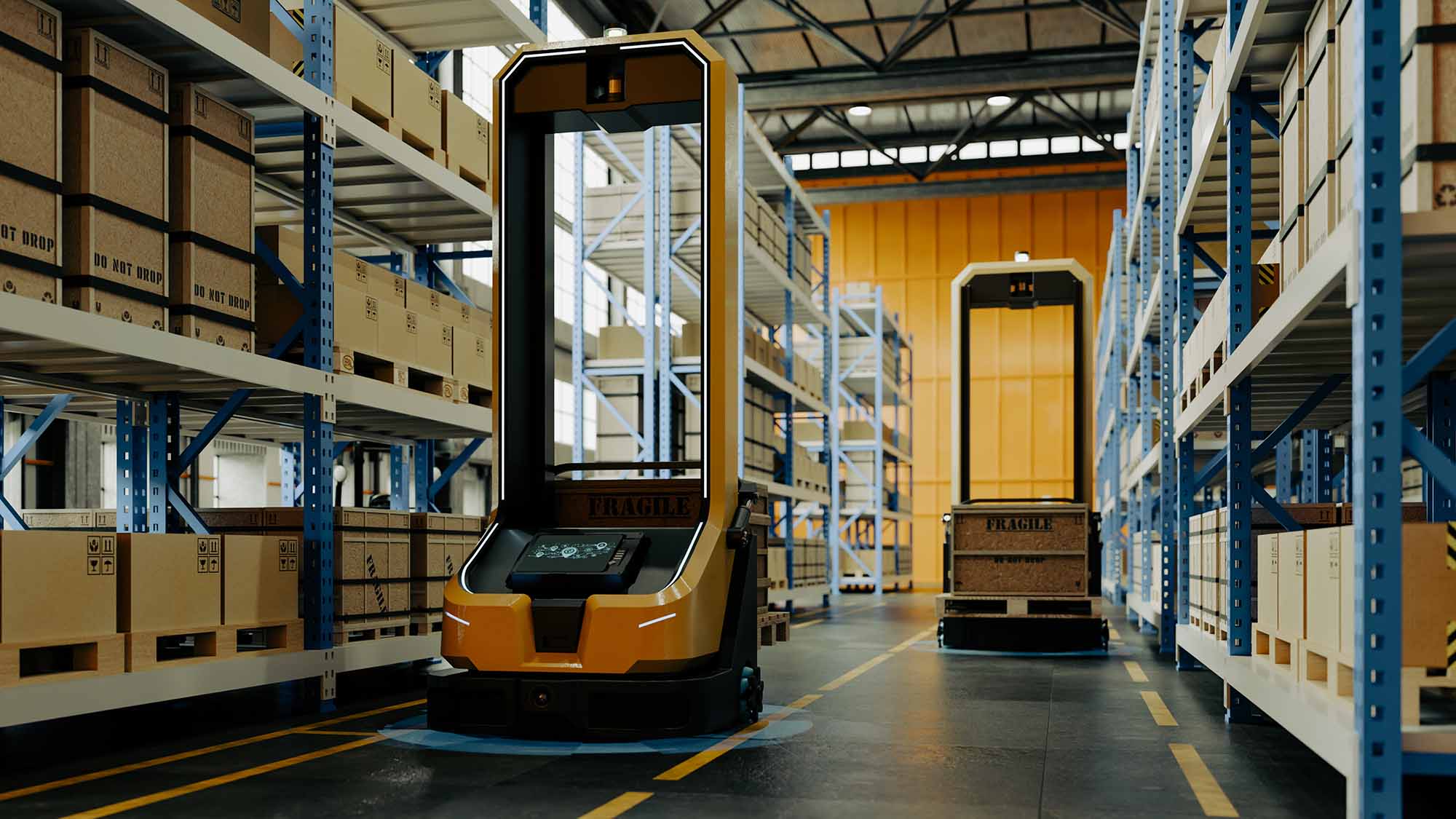
Still, some technologies are moving companies closer to autonomous operations. Warehouse automation and robotics are furthest along, with autonomous mobile robots, vision-based inspection, and AI-driven planning already accelerating fulfillment and improving efficiency in contained environments. Autonomous trucking and last-mile delivery robots also exist in active pilots and limited deployments, but they’re far from widespread commercial use.
Autonomy is the horizon to watch, not the stage most companies should be actively budgeting against today. The controlled environments where it’s furthest along, like warehousing, offer a preview of what will become possible once the harder, less flashy work of visibility, automation, and orchestration has been done.
SOLUTION SPOTLIGHT
Your AI roadmap needs more than a strategy deck. Make an impact with Catalant Forward Deployed Experts.
Learn MoreDiagnose Your Stage Before You Make Your Next Investment
The right question isn’t “which AI tool should we buy?” It’s “where do we actually sit on this curve?” asked function by function. Run a maturity audit for each function, covering procurement, planning, warehouse, last-mile, and fleet, before asking what tool to adopt. The stage question always comes first. It’s critical to know where you are in order to determine where to go next.
That unevenness in maturity can also be a guide, as most organizations aren’t uniformly at one stage. Warehouse operations might be deep into automation while network planning is still stuck at basic visibility. That’s normal, not a sign of falling behind, and you can use that gap to identify where to put your next dollar of AI investment.
A few key principles to remember:
- Build the data foundation before layering intelligence on top. Visibility-stage work, harmonizing formats across counterparties and reconciling data quality by partner, is the prerequisite every later stage depends on. Skipping it to chase automation or orchestration tools sets those investments up to underperform.
- Match organizational structure to the stage you’re targeting. Automation requires teams to trust system recommendations over manual judgment. Orchestration requires procurement, planning, and operations execution to coordinate closely. AI can’t manufacture cross-functional alignment that doesn’t exist. That’s a change-management problem, not a software purchase.
- Treat orchestration, not autonomy, as the current frontier. Most leading operators are moving from automation into orchestration, and very few have arrived. That’s where near-term competitive advantage is actually being won, through control towers, cross-system exception triage, and scenario planning.
- Keep autonomy on the horizon, not the budget. Track pilots in warehouse robotics and autonomous delivery, but don’t let headline pressure pull capital away from solidifying visibility, automation, and orchestration first. Autonomy’s ROI case depends on those foundations being in place.
The practical first step for most organizations is to stand up a lightweight maturity scorecard, scoring each function from stage one to stage four, as the entry point for any AI roadmap conversation. That single exercise helps you answer critical questions for your AI investment plan: which function should you invest in, at which stage, and with what expected payoff.
What’s next for your logistics org? We can help you measure where you are and where your AI investments will have the biggest impact.
Let’s TalkMeet the Author
Dirk Stammnitz is a Catalant consultant and Founder and Managing Director of Marblehead Consulting Group, where he advises clients on critical issues shaping today’s global supply chains, transportation networks, and the logistics technology landscape. With more than 25 years of experience in transportation, logistics, and supply chain strategy, Dirk helps Fortune 500 companies, mid-market firms, and high-growth ventures make more strategic investments and successfully transform supply chains from end to end. Dirk holds a Master of Business Administration from the University of Chicago Booth School of Business and a Bachelor of Science in Aeronautical Science and Engineering from Embry-Riddle Aeronautical University.
Logistics executives must assess AI maturity function by function across four sequential stages: actionable visibility, task-level automation, enterprise orchestration, and operational autonomy. Yet organizations rarely progress uniformly. Evaluating specific operational areas—such as procurement, transportation planning, warehousing, and fleet management—prevents over-investing in advanced orchestration tools before establishing essential data foundations and task automation.
Task-level automation executes isolated functions within single systems, whereas enterprise orchestration synchronizes real-time decision-making across disparate enterprise platforms. Orchestration integrates inputs from transportation management systems, warehouse management systems, and enterprise resource planning software. Cross-system coordination allows adjustments in procurement, routing, and warehouse management to dynamically inform one another rather than operating as isolated silos.
Premature capital allocation toward fully autonomous systems fails when organizations lack the necessary data harmonization, task automation, and cross-functional orchestration required to support independent execution. Operational autonomy carries high capital requirements, complex regulatory hurdles, and elevated risk profiles. Leaders achieve superior near-term returns by focusing capital expenditure on enterprise orchestration and cross-system control towers rather than fully autonomous assets.
Establishing a single source of truth through normalized data across a supply chain is the mandatory prerequisite for predictive AI. Insights from Raw logistics data often exists in inconsistent formats across dozens of external counterparties. Harmonizing disparate operational inputs and digitizing legacy paper records enables reliable predictive engines, such as dynamic estimated time of arrival calculations and automated risk flagging.
AI applications cannot generate operational value without aligned organizational structures and cross-functional change management. Moving from task automation to enterprise orchestration requires active alignment between procurement, planning, and operations teams. Software platforms cannot manufacture organizational coordination; management must establish internal trust in algorithmic recommendations and break down functional silos to capture cross-network efficiencies.