
Trends Retailers Must Pay Attention to in 2025

Generational shifts, media friction, and the new rules of engagement
If 2024 was about rebuilding momentum, 2025 is making one thing clear: retail’s future is being shaped by sharper generational divides, rising consumer expectations, and a fragmented commerce landscape.
As a consultant with over 15 years of experience working both within and for leading consumer organizations, I’ve had a front-row seat to retail’s evolution from traditional models to today’s complex ecosystem. Drawing insights from this year’s Shoptalk conference, industry data, and trends I’m seeing among my clients, it’s clear that success will hinge on adaptability, strategic innovation, and a deeper understanding of increasingly nuanced consumer segments.
For retail leaders, it’s time to recalibrate. Here are 5 trends that must stay top of mind:
1. Consumers Are Everywhere, and Retailers Must Be Too
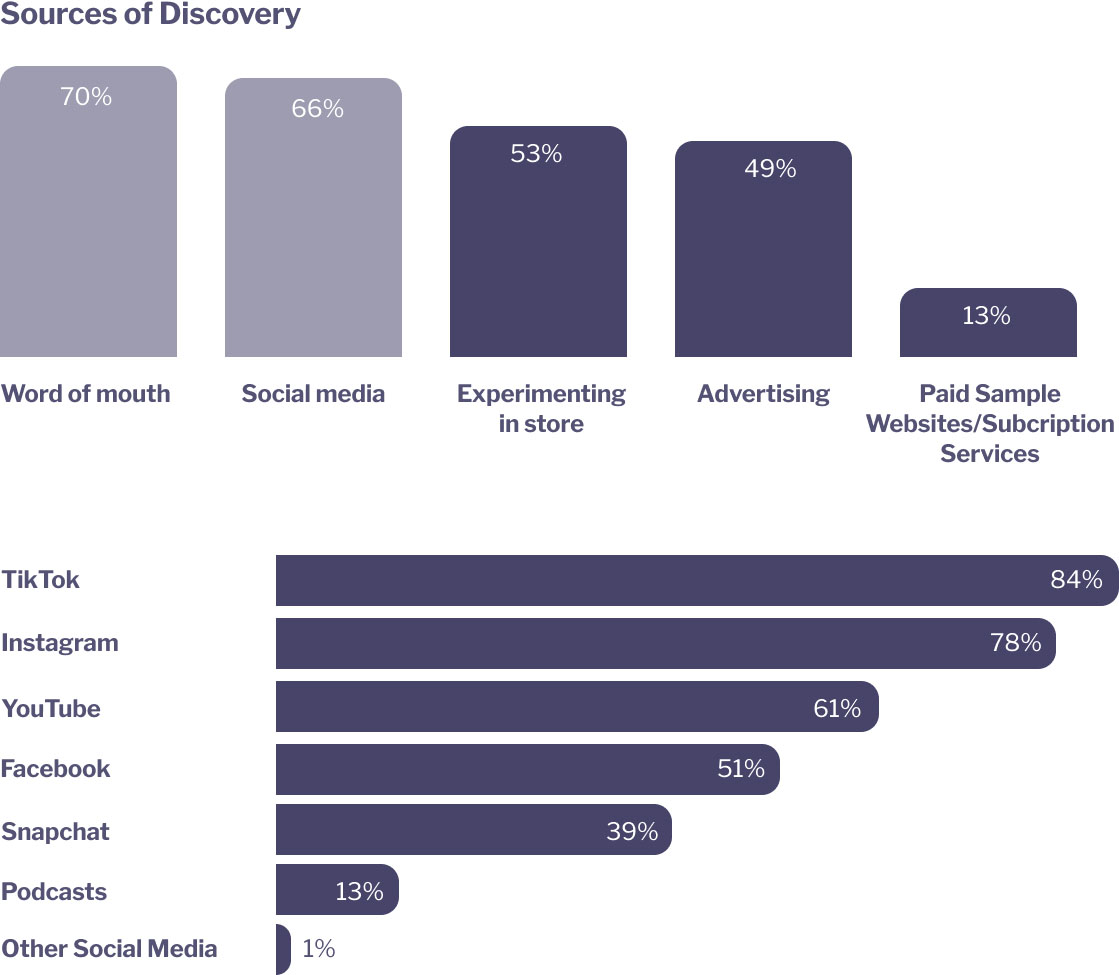
The days of thinking in terms of separate channels are over. Today’s retail leaders recognize that consumers move fluidly across touchpoints, with each generation exhibiting distinct preferences. Gen Alpha, already influencing $28B in household spending, discovers products primarily through word-of-mouth and video platforms like TikTok. Gen Z has embraced fast commerce platforms such as Temu and SHEIN at twice the rate of Gen X.
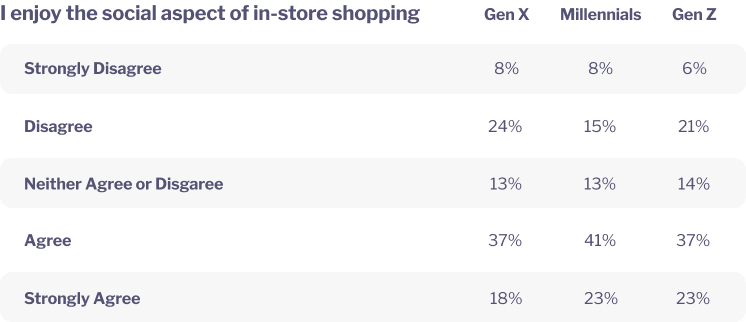
Despite these digital leanings, physical retail remains vital. Interestingly, Gen Z ranks in-store shopping as an experience they actively look forward to, underscoring the need for retailers to create consistent, connected experiences regardless of entry point. Even Gen X, often underserved by retail media and loyalty efforts, is active across multiple platforms.
The winning formula isn’t just about being everywhere—it’s about delivering relevant value everywhere. Retailers with the scale and infrastructure to engage across formats—store, app, social, and media—are positioned to win. Albertsons demonstrates this with 44 million loyalty members despite having a smaller digital footprint than competitors. Their success emphasizes that while reach matters, relevance matters more.
2. Retail Media Networks Enter a New Phase of Maturity
With U.S. retail media ad spend projected to reach $100 billion by 2029, we’re witnessing a significant shift from on-site to off-site strategies. As ad inventory reaches saturation on major platforms, advertisers are increasingly prioritizing off-site placements across connected TV, social media, and the open web to scale campaigns and engage new audiences. By 2027, one in four retail media dollars will be allocated to off-site channels.
Source: Merkle Shoptalk presentation
This evolution brings new challenges. According to Circana, 82% of advertisers report that media costs are prohibitively high, and over half struggle with interoperability across Retail Media Networks (RMNs). Performance attribution and consistent measurement remain persistent challenges.
To stay competitive, retailers must invest in unified infrastructure and foster cross-functional collaboration. RMNs can no longer operate as siloed revenue centers—they must function as comprehensive performance marketing engines that deliver measurable value to brand partners while enhancing the consumer experience.
3. AI Implementation Moves from Experimentation to Practical Application
While AI remains a focal point in retail innovation, we’re still in the early stages of realizing its full potential. Forward-thinking companies are moving beyond the hype to implement practical solutions. Nestlé Purina has integrated GPT tools to enhance content creation and customer service, while Wayfair is leveraging AI to improve product discovery and personalization.
Still, most efforts remain foundational. The most substantial traction is happening where AI addresses specific operational challenges, such as inventory planning, fulfillment optimization, and predictive analytics. Though current impacts may appear incremental, the direction is clear. Retailers investing in scalable AI infrastructure today are positioning themselves for significant competitive advantages tomorrow.
4. Social Commerce Evolves Beyond Transactions
While social commerce continues to grow, successful retailers understand that these platforms are about more than just driving immediate sales. They’re powerful tools for brand building, community cultivation, and authentic engagement. Platforms like TikTok and Instagram are increasingly functioning as search engines for younger consumers; for example, Mintel reports that 69% of Gen Zers turn to TikTok to learn about beauty products.
The retailers seeing the greatest success in social commerce are those focusing on creating valuable, entertaining content that resonates with their target audiences rather than pushing transactional messaging. They’re leveraging creator partnerships that feel genuine and investing in building communities around shared interests and values instead of products alone.
This doesn’t mean the physical store is dead. Quite the opposite. With all the buzz around AI and digital media, it’s easy to overlook the fact that the oldest retail channel—brick-and-mortar stores—still accounts for 80% of all retail sales. Factor in that many retailers now use stores as fulfillment hubs for digital orders, and it’s clearer than ever: physical stores remain essential. As retailers double down on digital and tech-enabled initiatives, the fundamentals still matter: clean stores, stocked shelves, and great service. These basics remain as powerful as ever—especially when attracting younger shoppers, and those shoppers are the ones leading the charge back to stores.
Source: Merkle Shoptalk presentation
5. Consumer Caution Will Shape Strategic Planning
A notable undercurrent at Shoptalk 2025 was a sense of restrained optimism—markedly different from the exuberance of recent years when concepts like the Metaverse dominated discussions. Despite historically strong Q4 earnings reports from many large retailers, there’s a palpable sense of caution permeating the industry.
As aptly noted by Simeon Siegel from BMO Capital Markets, “You shine when things are tough, not when things are easy.” This environment creates a natural selection process where retailers with disciplined execution and operational excellence will outperform regardless of whether we’re experiencing a true economic slowdown or what some have termed a “vibecession”—a disconnect between strong economic indicators and cautious consumer sentiment.
The absence of C-level executives from major retailers who were regular keynote speakers in past years—including leadership from Target, Nordstrom, and Ahold Delhaize—further reinforces this cautious mindset.
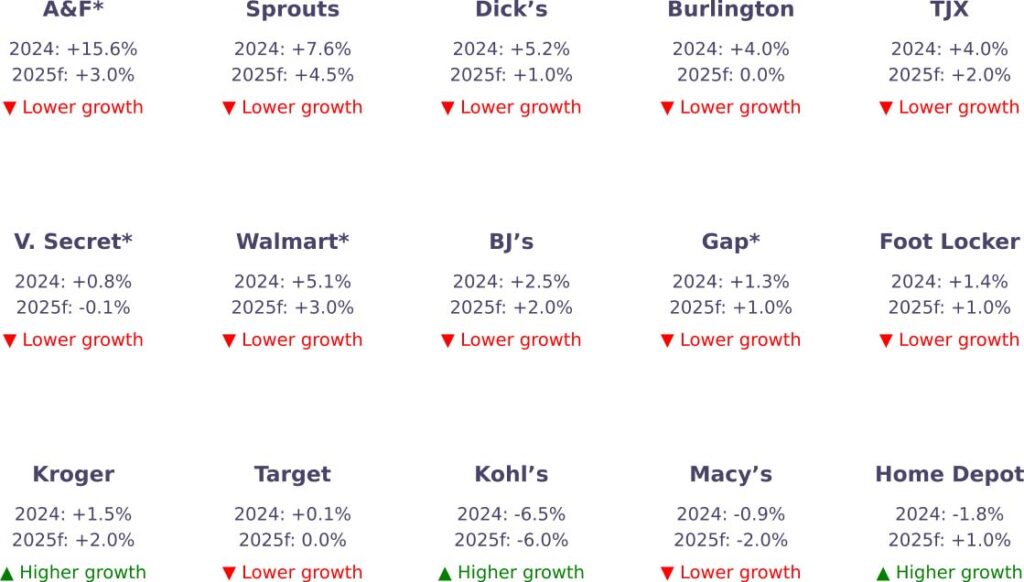
According to Neil Saunders from GlobalData Retail, who recently provided a numerical breakdown of retailer sentiment, companies are strategically recalibrating expectations for 2025:
Source: GlobalData
This trend means retailers must balance prudent financial management with continued investment in innovation. The winners will be those who maintain growth initiatives while implementing strategic cost optimization—focusing resources on high-impact areas rather than pursuing every emerging technology or market opportunity.
Orchestration as the New Retail Imperative
The common thread connecting these trends is orchestration—the ability to coordinate multiple elements into a coherent, consumer-centric strategy. From loyalty programs to media networks to operations, retailers must meet customers where they are with approaches designed for speed, relevance, and scale.
The retailers who will thrive in 2025 aren’t those with the most channels or the most advanced technology in isolation. They’re the ones who can orchestrate these elements into seamless experiences that recognize and respond to the nuanced preferences of different consumer segments while delivering consistent value across touchpoints.
As generational divides sharpen and the commerce landscape continues to fragment, this orchestration capability will separate the industry leaders from those struggling to keep pace with change. For retail executives, the mandate is clear: build the organizational capabilities, technological infrastructure, and strategic mindset needed to orchestrate excellence across an increasingly complex ecosystem.
Is your business ready to tackle these trends?
Let’s TalkMeet the Author
Carlos Castelán is a Catalant consultant and a retail executive with extensive operations and consulting experience who thrives on the challenges of growing businesses, developing strategy via analytical insights, and solving complex challenges. Carlos has 15+ years of expertise in omnichannel retail including both digital and brick-and-mortar business models. He holds a B.A. and B.S. in International Studies and Economics from the University of St. Thomas and an M.B.A. from Harvard Business School.
Physical stores remain a critical experiential touchpoint, as younger generations actively seek in-store shopping despite their digital-first discovery habits. According to Catalant consultant Carlos Castelán, Gen Alpha already influences $28 billion in household spending through platforms like TikTok, yet Gen Z ranks in-store shopping as a preferred experience. High-performing retailers are leveraging stores as fulfillment hubs while maintaining operational basics like stocked shelves and service. This orchestration of physical and digital formats ensures that retailers meet fluid consumer movements across all touchpoints to drive long-term loyalty.
As on-site ad inventory reaches saturation, retailers must transition to off-site placements across connected TV and social media to scale brand reach. This requires RMNs to move beyond siloed revenue centers and function as comprehensive performance marketing engines. To overcome high media costs and interoperability challenges, retailers must invest in unified infrastructure that provides brand partners with consistent measurement and clear performance attribution across the open web.
Retail leaders are achieving competitive advantages by applying AI to specific operational challenges rather than broad, unproven concepts. Forward-thinking organizations like Wayfair and Nestlé Purina utilize AI for practical applications such as inventory planning, fulfillment optimization, and predictive analytics. While foundational GPT tools enhance content creation, the most substantial ROI stems from scalable AI infrastructure that addresses supply chain efficiency. Retailers focusing on these high-impact operational areas are better positioned for sustainable growth than those pursuing every emerging technology.
Social commerce must evolve beyond transactional messaging toward authentic community cultivation and entertaining content. A majority of Gen Z consumers use TikTok specifically to learn about products, treating social platforms as primary search engines. Success in this fragmented landscape requires genuine creator partnerships rather than traditional advertisements. By focusing on shared values and entertaining engagement, retailers can build brand equity that resonates with younger demographics who prioritize authenticity over simple digital transactions.
Retailers must balance strategic cost optimization with disciplined investment in innovation to outperform during periods of consumer caution. Even with strong earnings, a disconnect between economic indicators and cautious consumer sentiment—often called a vibecession—requires a recalibration of expectations. According to Catalant consultant Carlos Castelán, the natural selection process will favor retailers with operational excellence and disciplined execution. Leaders are strategically focusing resources on high-impact initiatives and orchestration capabilities rather than the exuberant, speculative spending seen in previous years.