

5 Ways AI Is Actually Changing Healthcare in the Here and Now

By now you’ve probably had your fill of articles that breathlessly assert that in the world of AI, the future is now. Well yes, the future is now – or at least, now was the future. That’s how time works. But if you really want to know what the future holds with AI in healthcare, you really should look to the present. Its potential lives in solving pain points, improving the less-than-ideal, and making what feels just out of reach possible.
That’s where AI is getting the best results.
Healthcare is highly regulated and famously risk-averse. Lives are literally on the line, and where a “mostly reliable” tool might be acceptable in other industries, in healthcare, it falls short of the mark. So while AI designed to make open-ended judgments might be ready for other industries, the AI applications gaining traction in medicine are focused on solving specific, bounded, well-understood problems. The technology will undoubtedly improve and find more use cases, but there are areas where it’s making a real difference in the here and now. Let’s explore five of those areas where it’s already paying off and the limits that point to what developments could come next.
1. Reading Scans Faster and Catching More Than the Human Eye Does
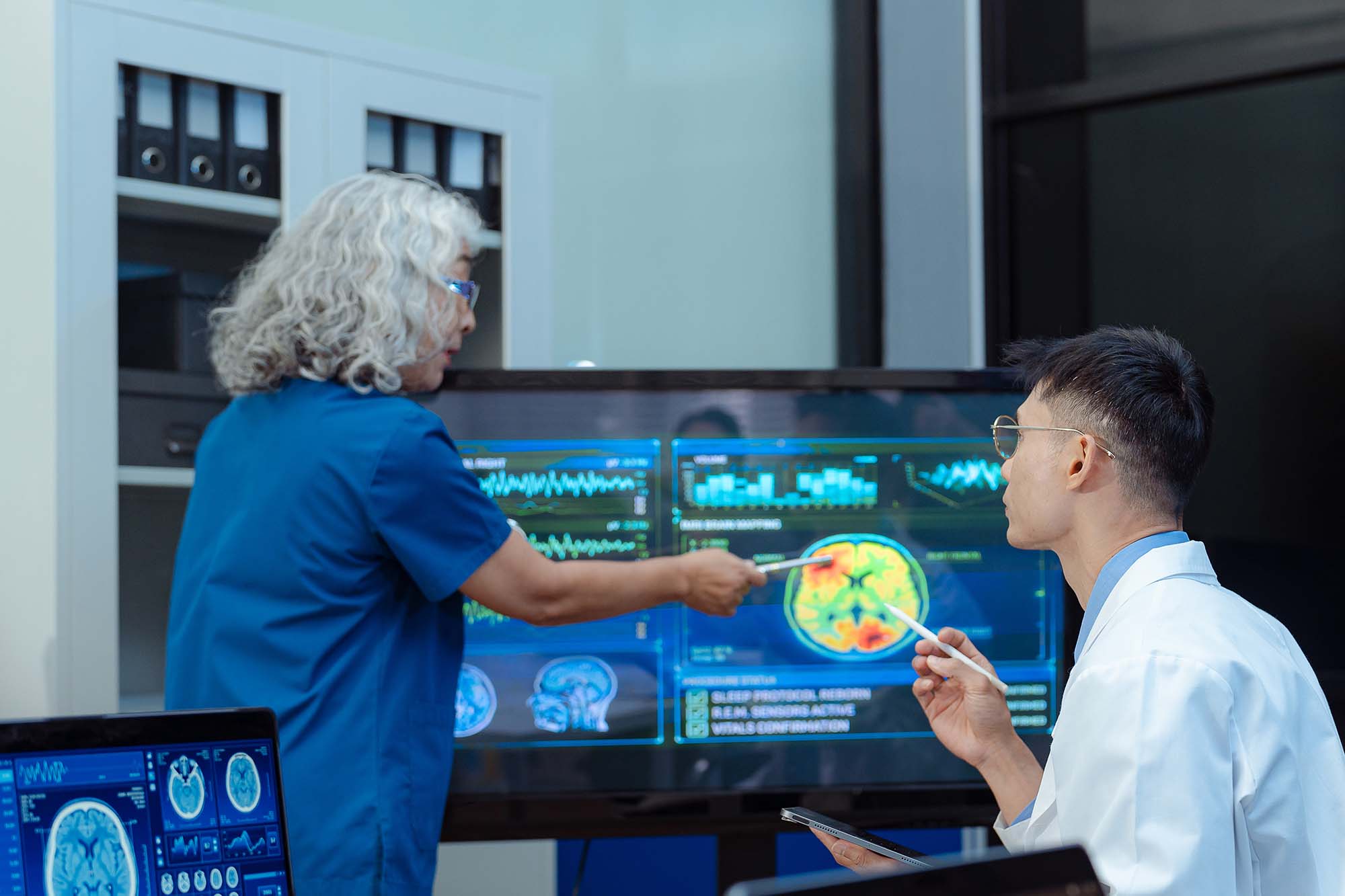
Radiology and pathology are where AI has had the longest runway to prove itself, because the task of finding an anomaly in the image fits snugly in the kind of pattern-matching wheelhouse these models are built for. In fact, radiology accounts for 76.5% of FDA-cleared AI devices since 1995. The results are compelling. These tools that are catching barely perceptable early-stage tumors that may otherwise slip past a tired eye at the end of a long shift. While AI isn’t replacing the radiologist’s judgment, it’s at least providing a second consultation on the fly.
How It Works
The model is trained on a large library of scans that have already been labeled by radiologists. It learns the visual signature of what it’s looking for, then when it sees a new scan, it flags the regions that look suspicious and ranks how confident it is. A radiologist still reads the scan; the model just makes sure nothing gets skipped over.
Where There’s Still Room for Improvement
These models are only as good as the data they were trained on, and most training sets skew toward certain populations, certain scanner brands, and certain hospital systems. A model that performs beautifully at the academic medical center that trained it can perform worse at a rural clinic with older equipment and a different patient mix. There’s also the trust problem: a flagged region with no explanation of why it was flagged is a hard thing to act on with confidence, which is why new tools are taking both accuracy and explainability into consideration.
2. Making the Note-Taking Disappear
Ask any clinician what they hate most about their job and “the paperwork” is usually somewhere near the top. Ambient documentation tools — the ones that listen to a visit and draft the clinical note in real time — are a rare AI use case that clinicians actually ask for, rather than have imposed on them. It’s not glamorous. It’s not going to cure anything. But it’s solving a burnout problem that’s been quietly draining the workforce for years, and that alone makes it worth a spot on this list. It’s also putting the clinician’s focus back onto the patient and away from the computer monitor.
How It Works
A microphone (often just the clinician’s phone or a device in the exam room) picks up the conversation during a visit. Speech recognition turns it into a transcript, and a language model organizes that transcript into a clinical note — history, assessment, plan — using the clinic’s preferred format. The clinician reviews and signs off rather than typing from scratch.
Where There’s Still Room for Improvement
These tools are good at capturing what was said, but they cannot pick up what was implied or a telling gesture that communicates the unsaid: a raised eyebrow, a long pause, a “we’ll keep an eye on that” that means more than it sounds like. There’s also a real risk of clinicians rubber-stamping a note without carefully reviewing it, which defeats the purpose of having a human in the loop at all. And every one of these tools is, by design, listening to the most sensitive conversation a patient has all year, so it goes without saying that the security and consent expectations have to match that.
SOLUTION SPOTLIGHT
Your AI roadmap needs more than a strategy deck. Make an impact with Catalant Forward Deployed Experts.
Learn More3. Catching Trouble Before it Becomes an Emergency
In the ICU, and increasingly through remote monitoring, AI systems are watching the vitals nobody has time to watch continuously — heart rate, oxygen, blood pressure — and flagging the subtle shifts that precede a crisis. This is AI as an early-warning system, not a decision-maker. The value isn’t that the machine knows more than the care team; it’s that the machine never looks away.
How It Works
Sensors stream continuous data consisting of everything from vitals to lab values, sometimes even device readings, into a model trained to recognize the early patterns that historically precede events like sepsis or cardiac arrest. Instead of waiting for a single reading to cross a hard threshold, the model looks at the trajectory across many signals at once and raises an alert when the combination looks like the early chapters of a bad outcome, often hours before a human would notice.
Where There’s Still Room for Improvement
Alert fatigue is the whole ballgame here. If the model cries wolf too often, staff start tuning it out, which defeats the purpose entirely. Getting the sensitivity right by catching real deterioration without burying the care team in false positives is still more art than science, and it has to be tuned differently for every unit and patient population. There’s also a question of accountability: when an alert fires, a clinician overrides it, and something goes wrong, whose judgment was actually in charge?
4. Bringing Precision to the Exam Room
Too often, treatment plans are based on “standard” protocols—what works for the average patient—rather than what’s specific to the individual sitting in front of the clinician. AI is changing this by integrating genetic data, patient history, and local epidemiological trends in real time to suggest highly tailored treatment paths. Instead of a “trial and error” approach to finding the right medication or dosage, clinicians can see data-backed recommendations that account for the patient’s specific biology. This is as much about raising the standard of care as it is about efficiency: it shifts the baseline from educated guesses to personalized precision.
How It Works
The system acts as a real-time clinical decision support tool. During an exam, it pulls from the patient’s electronic health record and integrates it with massive, anonymized datasets to identify which therapies have been most effective for people with similar genetic markers, comorbidities, and demographic profiles. It then presents these insights to the clinician as a suggested path, allowing the doctor to validate the recommendation and adjust treatment from there.
Where There’s Still Room for Improvement
The efficacy of these tools relies entirely on the quality and breadth of the data they can access. If a system doesn’t have a robust, diverse dataset, it risks reinforcing existing health disparities rather than solving them. Additionally, there’s a risk of automation bias, where clinicians might defer to the system’s suggestion without considering nuanced patient factors that the AI might have missed. Balancing data-driven precision with the clinician’s unique insight remains a critical human-in-the-loop challenge.
5. Getting People to the Right Kind of Care, Faster
Symptom-checking and triage tools such as chatbots and AI-assisted telehealth intake are extending access in places where “see a doctor” has traditionally meant a long drive or a long wait. This is also the entry in this list that deserves the most skepticism, because the failure mode isn’t a bug in the usual sense. Babylon Health’s high-profile collapse in 2023, after years of scrutiny over its symptom checker’s clinical accuracy, is a useful cautionary tale. A triage tool that reassures someone when it shouldn’t or misses a red flag has failed at the one job it exists to do. The tools worth celebrating are the ones built around that risk from the start, not the ones optimized mainly for convenience.
How It Works
A patient describes symptoms conversationally, whether by voice or text, and the system asks follow-up questions modeled on how a clinician would triage over the phone. Based on the responses, it recommends a level of care: this can wait for a regular appointment, this needs urgent care today, this needs an emergency room now. Some versions route directly into a scheduling or telehealth system so the recommendation turns into an actual next step.
Where There’s Still Room for Improvement
The cost of being wrong is asymmetric. Under-triaging a serious symptom is far more dangerous than over-triaging a minor one, which means these tools have to be tuned toward caution in a way that can frustrate users who just wanted a quick answer. They’re also only as good as the person’s ability to describe what they’re feeling, which varies a lot by language, health literacy, and how anxious someone is in the moment. And a chatbot’s bedside manner is still a poor substitute for a human who can reassure or calm the patient when they’re scared.
What Comes Next
While the technology will most certainly march on and more will be possible, adoption will take both the trust of patients and practitioners to truly revolutionize medicine. AI creates opportunities to address the myriad shortcomings in our medical systems today, from alleviating administrative burdens to expediting exciting medical advances.
AI use cases actually gaining traction in healthcare are the ones augmenting a specific, well-defined task: read this scan, write this note, or watch this vital sign, rather than the ones promising to reason their way through open-ended clinical judgment. In no way is that a knock on the technology, it’s just a more useful way to tease the best use-case out of the miasma of hype about the shipping product.
It also points to where the real bottleneck sits. None of these five use cases failed or succeeded because of the underlying model. They succeeded or struggled based on execution: whether the training data reflected the actual patient population, whether the alert thresholds were tuned for the specific unit, whether clinicians were brought into the design process instead of handed a finished tool. The health systems getting this right are treating AI deployment as an operational discipline, not a procurement decision. They’re pressure-testing tools against their own patient mix before rollout, building the governance to catch a model drifting out of calibration, and considering the unglorious work of change management alongside the technology itself.
Considering what’s next on your AI roadmap?
We can helpHealthcare AI achieves optimal adoption when scoped to discrete, task-specific functions rather than broad diagnostic reasoning. High regulatory hurdles and strict risk aversion require near-zero error margins that open-ended models cannot consistently guarantee. Consequently, bounded applications—such as image anomaly detection, which accounts for 76.5 percent of FDA-cleared artificial intelligence devices—deliver more immediate ROI by augmenting narrow clinical workflows without displacing physician oversight.
Ambient documentation software captures physician-patient conversations in real time, converting raw audio into structured electronic health record entries. Eliminating manual data entry directly mitigates clinician burnout and shifts focus back to direct patient care. However, health system leaders must maintain strict human-in-the-loop review processes to prevent over-reliance on automated notes and ensure compliance with strict patient privacy standards.
Successful deployment requires treating AI integration as an operational discipline rather than a technology procurement choice. Model accuracy depends heavily on localized implementation factors. Enterprise leaders must pressure-test algorithms against local patient demographics, establish continuous model-calibration governance, and actively engage clinicians in design to prevent operational friction, alert fatigue, and algorithmic performance drift.
AI early-warning systems process continuous vitals, laboratory values, and device metrics to detect subtle physiological deterioration hours before visible clinical events occur. These algorithms operate as persistent monitoring layers that evaluate complex data trajectories rather than single static thresholds. To maximize clinical utility, healthcare administrators must continuously fine-tune alert sensitivity to prevent false positives and clinician fatigue.
Automated triage platforms extend healthcare access by evaluating patient symptoms and directing individuals to appropriate care settings. Clinical safety risks in triage tools are highly asymmetric, as under-triaging severe conditions carries critical liability. Sustainable deployment demands conservative calibration, robust data governance, and seamless routing into live clinical channels to avoid high-profile operational failures seen in pure convenience-oriented digital tools.