











What it Takes to Get Consumer Transformation Right


Consumer companies have struggled to achieve sustained profitable growth in the past few years, and the business environment is only growing more difficult to navigate. That’s for a variety of reasons. Supply chain volatility has been a constant since the start of the COVID pandemic. Now tariffs are driving up costs, forcing companies to rethink sourcing, pricing, and cost structure. What cost companies can’t absorb is passed on to consumers, and it’s changing their behavior.
Inflation and tariffs have accelerated the trend toward value shopping, but it’s become commonplace even without economic pressure. Even higher-income consumers are now looking to save. In fact, nearly half of global consumers are now considered value shoppers, regardless of income level. While consumers trade down, costs continue to rise, leaving consumer companies struggling to grow margins. You can see this reflected in the fact that the S&P Consumer Index underperformed the broader S&P index by more than 10% last year.
Leaders in the consumer industry are turning to transformation as the answer to top-line growth and profitability. It’s never easy, but the programs that work tend to follow similar patterns.
Five functional pillars of consumer transformation
The transformations I’ve worked on map back to one of two business initiatives: grow or operate more efficiently. In consumer, the five functional pillars where transformation investment happens all fit that framework. Most programs have a primary focus on one, with ripple effects across the others.
- GTM transformation is the growth pillar, and it remains an ongoing priority for consumer companies, even when economic conditions make it harder to achieve. The driving question is always the same, “How do we better connect with our customers and grow our share of wallet?” In practice, that translates into sales and marketing efficiency. Projects might include Salesforce redesign, creative agency consolidation, or spend optimization around marketing and trade dollars.
While these initiatives are important, you don’t take sales to the bank; you take profit to the bank. The other four pillars are all, in some way, about the bottom line. - Finance transformation hinges on seeing material improvements in cost and speed. We see finance transformation after M&A activity, which is a constant in consumer companies. Every merger or acquisition raises the same questions around integrating systems and processes: Best of breed? One platform? Absorption? Hybrid? Every organization and every M&A is different, so it takes time and resources to work through every single time. When margins are tight and unpredictable, companies need their finance departments to move faster and cost less. Finance transformation can help them get there.
- IT transformation follows a similar pattern. On one track, companies are cleaning up after M&A: reconciling unconsolidated data centers, fragmented application portfolios, and mounting technical debt. On the other, they’re making IT leaner, lately by outsourcing and applying AI to workflows to drive down costs. These two forces are continual, so consumer goods companies go through frequent life cycles of IT transformation.
- HR transformation usually happens on a three to five year rolling cycle. Compensation and benefits tend to grow above the inflationary rate, and this unpredictable inflationary environment makes margins hard to plan around. Organizations face a continual process of figuring out how to rightsize and optimize cost. People orgs are also figuring out how AI fits into their workforce model alongside the constant pendulum swing between insourcing and outsourcing.
- Supply chain transformation deals in two categories: procurement and operations. Costs are hard to predict, so procurement spend optimization is a key part of transformation because the financial impact is substantial. On the operations side, we see the familiar need to clean up after M&A. Companies are left with disconnected manufacturing and distribution footprints that are difficult and expensive to rationalize. Getting it right takes time, but supply chain transformation is a big driver of quality and reduction in cost.
These five pillars are ongoing programs driven by the cycles of the consumer business. M&A activity constantly reshapes systems and org structures. And with current tariff uncertainty, shifting consumer behavior and unpredictable inflation, the pressure to act is high.
But external forces are only part of the story. Internal factors almost always determine the ultimate success or failure of a transformation program.
What consumer leaders are up against
No two consumer transformations are the same, but they tend to face similar internal challenges. Here’s how to handle them.
Structural challenges
Part of the reason transformation is difficult in consumer industries—especially large, multinationals—is because they typically have a matrix structure. Let’s take marketing transformation as an example. You might have a global marketing group, marketing teams that support regions, and marketing organizations that support individual brands. Everyone has their own way of working and idea of what they want to achieve with a transformation initiative. If directives don’t cascade clearly, they’ll get lost in the matrix.
Coordination in a matrix structure is hard enough in stable conditions. But today’s margin pressures demand fast, aligned decision coordination across the whole organization. A slow cascade won’t cut it.
The human element
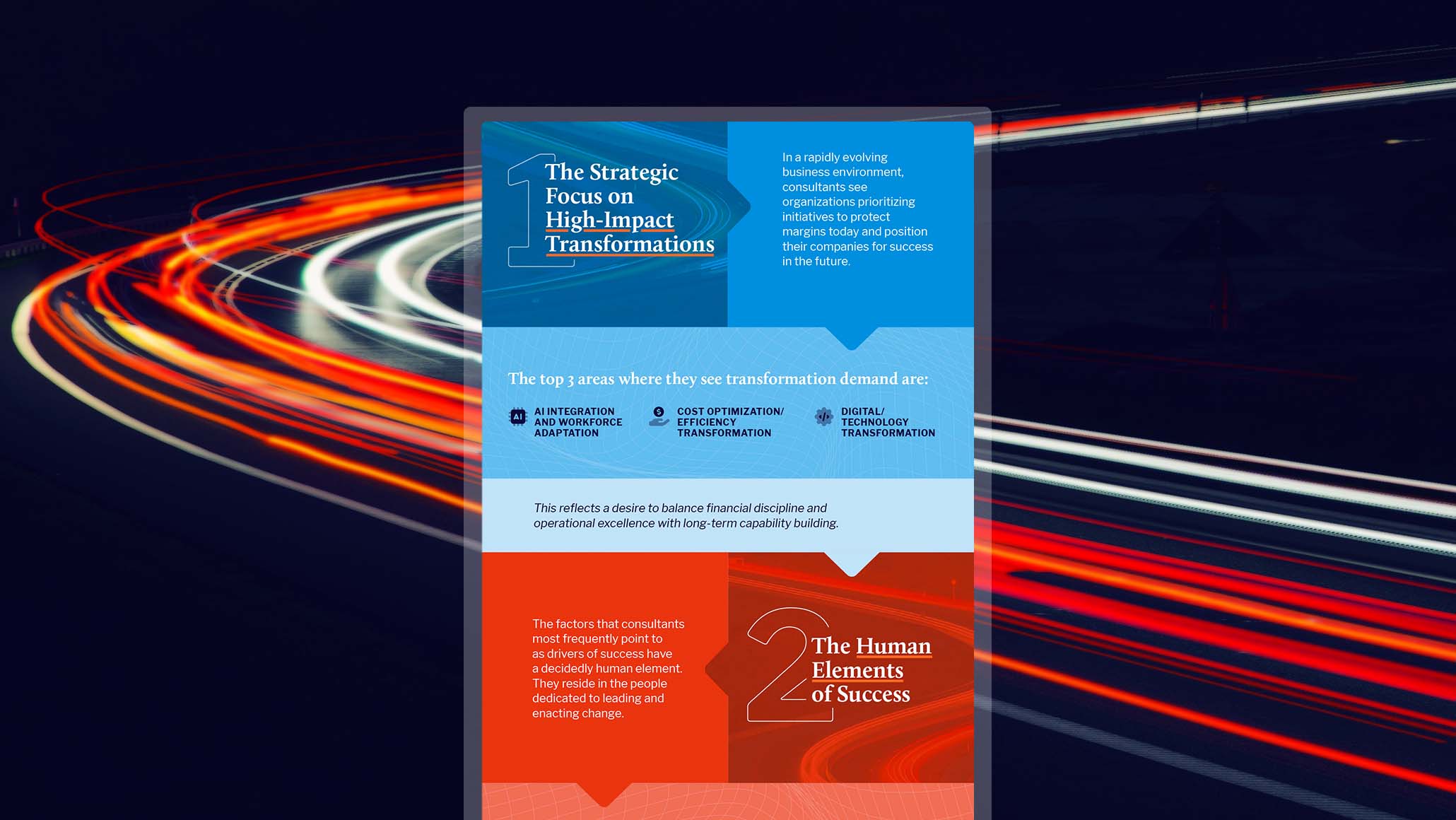
Ultimately, the people filling in the org chart will make or break a transformation initiative. In our recent survey of consultants, 93% agreed that organizations underestimate the cultural factors of transformation to their detriment. Here’s why.
When you announce a major transformation program, people at every level are doing the calculus to figure out how it will affect them, especially when they’re aware of the headwinds facing consumer companies. If the vision isn’t clear, they may put protecting their jobs above supporting the program.
For employees to be invested in the project’s success, you need to give everyone a view into how the transformation will improve their day-to-day. Just getting a PowerPoint slide once doesn’t suffice. You need ongoing support and explanation. Show progress, track KPIs, and celebrate wins.
An enterprise transformation office can go a long way to getting people on board with a transformation. Communicating something as simple as a project name shows there’s an integrated vision and real tactical plan they can get behind.
AI isn’t a strategy
AI is everywhere in conversations about transformation right now, but that doesn’t mean it’s actually driving transformation. Transformation is always driven by a business need. AI enables organizations to grow and become more efficient and gives them better tools to mitigate the risk that comes with operating at scale.
AI is how you enable certain elements of transformation, not why you do it.
In practice, AI can contribute to transformation in three ways. It can give you deeper and better insights faster. In consumer research, for example, AI can synthesize large amounts of data so we can quickly create better products, better packaging, and even new categories. It drives efficiency by completing certain tasks like order-to-invoice with greater accuracy than people. And it improves decision making by contextualizing signals like ESG exposure, competitive activity, and sentiment, that would otherwise require a significant manual effort to analyze.
Most consumer companies are in the early days of AI pilots, and they’re not seeing huge results yet. The vast majority of AI projects fail, or at minimum don’t produce the targeted benefits. MIT’s Project NANDA study found that 95% of generative AI pilots produce no measurable return. Most are deploying AI as tactical point solutions that are useful in isolation but not connected to a broader transformation strategy. That’s where the industry is today, but it will evolve. The way to get the most out of AI for transformation is to start with a clearly defined business need and then figure out how AI might enable it, not the other way around.
Why consumer transformations stall
Left unmanaged, organizational complexity, human dynamics, and technology distractions can sink a transformation program. In my experience, these issues tend to stall transformations in the same three ways.
- Lack of executive alignment and governance
When leadership isn’t aligned on goals, scope, and how much to rely on external partners, that tension cascades through the organization. In consumer companies with matrixed structures and competing brand and regional priorities, misalignment derails progress fast. Without a senior sponsor actively driving coordination, ideally through an enterprise transformation office, ownership and accountability break down. Different groups move at different paces, and no one considers interdependencies. When that happens, the initiative starts feeling like several competing transformation projects instead of one. - Poor planning
Most companies come with a high-level vision of what they want to achieve but haven’t worked through the tactics required to actually get there. When they get to work, they’re missing pieces. Without the right resources committed to the right workstreams, a transformation isn’t going to succeed. - Treating communication and change management as an afterthought
During a transformation, people fill in the blanks themselves in the absence of official communication. That’s why communication needs to be a priority from the start. All employees need visibility into how the transformation will affect them and to be kept informed of progress along the way. People need to see the program moving in the right direction to stay invested. The stakes of getting it wrong are higher than most leaders realize.
When consumer transformations succeed
The environment consumer companies face now makes transformation feel more urgent than ever. But urgency without clearly defined goals and thorough planning is one of the surest ways to fail.
My advice to leaders heading into transformation is straightforward: be thoughtful, be clear, and be conservative.
Thoughtful means defining what you’re trying to accomplish and being honest about how it will land across the organization.
Clear means having a communication strategy that spans the initiative and the organization. Clarity in transformation is an ongoing narrative that keeps the whole company aligned, not a one-time PowerPoint presentation.
Conservative means being realistic about timing. The vast majority of transformations I’ve been involved in have been driven by a desire to move fast, sometimes at the expense of clear strategic and tactical planning. Speed can feel like progress, but you won’t realize your objectives if the team hits the field not knowing the playbook. Transformation projects that succeed have been well thought out. There’s deliberate planning, executive alignment, and organizational buy-in before the whistle blows.
Looking for a consumer transformation partner who knows the ropes?
Let’s talkMeet the Author
Gregg Clark is Managing Director, Consumer at Catalant, leading the company’s consumer business and bringing the value of Consulting 2.0 to consumer and retail companies. He also acts as faculty for the Institute for Mergers, Acquisitions and Alliances, a global not-for-profit M&A think tank and educational provider. Prior to joining Catalant, Gregg held senior management positions leading consumer strategy at EY, Accenture, and Capgemini, and he led Serenity Strategy, an independent consulting firm supporting leading enterprises through business strategy, digital transformation, advanced analytics, and M&A strategy and execution, for nearly 10 years. Gregg holds a Bachelor of Science in Electrical Engineering/Industrial Management from Purdue University.