











Lessons in Transformation from Everest Base Camp


Corporate transformation today is characterized by extreme volatility and high-stakes decision-making. These conditions mirror the grueling environment of high-altitude trekking, where the margin for error is razor-thin and survival depends on more than a predefined roadmap. Navigating an organizational pivot requires a departure from traditional management styles, favoring a mindset that prioritizes real-time adaptation over rigid adherence to historical decisions.
Catalant consultant Ketul Patel, a former transformation leader at Deloitte and retail supply chain executive, explores this intersection of mountaineering and business strategy in his new book, A Journey of Elevation: Lessons for Business Transformation from Everest Base Camp.
To celebrate the book’s launch, Catalant CEO Pat Petitti hosted a fireside chat with Ketul to discuss how his experience on the mountain changed his perspective in the boardroom. Their conversation highlighted a critical truth: successful transformation begins with a fundamental shift in how leaders perceive their own authority when the pressure rises.
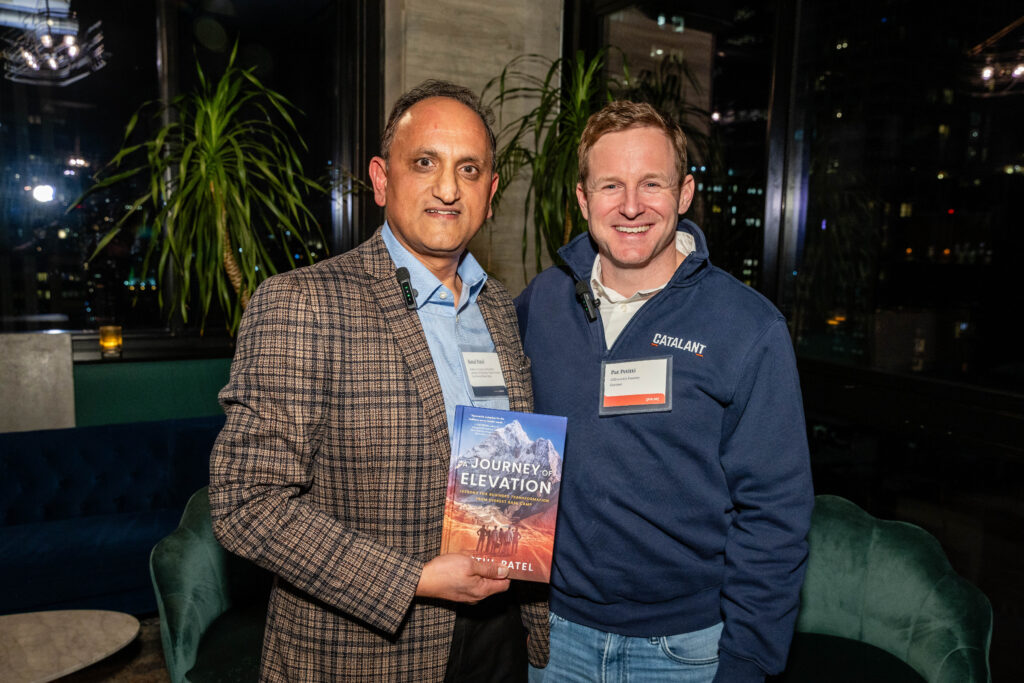
Consultant Ketul Patel and Catalant CEO Pat Petitti at the fireside chat for the launch of A Journey of Elevation: Lessons for Business Transformation from Everest Base Camp.
Highlights from their conversation apply the lessons Ketul learned on Everest to provide a blueprint for how leaders can better prepare themselves and their teams for transformation.
The illusion of control: Leading in volatile environments
Traditional “command and control” leadership fits stable environments where predictability is high. During periods of organizational upheaval, this approach becomes perilous. When leaders attempt to force a predetermined pace on a volatile situation, they ignore the reality that external conditions — much like the weather on Everest — dictate the terms of progress.
A perfect example is the experiences companies are having today in the wake of the Supreme Court decision declaring certain tariffs illegal. For many organizations, this wasn’t just a policy change; it was a sudden, uncontrollable event that rendered previous financial roadmaps obsolete overnight. Leaders who try to command their way through this by sticking to original budget targets are ignoring the reality of the new terrain.
True leadership requires the tactical ability to observe conditions and adjust in the moment. Yet the control leaders believe they possess is often an illusion. At 17,000 feet, the challenge transitions from physical capability to a mind-over-body struggle, where humility is a requirement for survival. Leaders must trade rigid milestones for an acute awareness of their environment, slowing down or pacing the organization as conditions demand.
There are two separate types of leadership mindsets, appropriate for different scenarios and environments:
- The expert mindset (for stable environments): Rooted in the belief that the leader must know everything; it relies on a fixed pace, static plans, and projecting confidence through an established roadmap
- The transformation mindset (for volatile environments): Built on humility and the ability to pace the organization; it prioritizes observing real-time feedback, practicing teamwork, and maintaining the presence to adjust when the altitude changes
Ignoring the environmental volatility that arises during large-scale transformation — or sudden legislative shocks — leads to strategic burnout. When a leader refuses to adjust to the reality of a crisis, they exhaust their team’s mental and physical resources by fighting unchangeable conditions. This realization shifts the strategic focus from the long-term plan to the immediacy of execution.
Planning vs. execution: Embracing “Plan C”
Strategic success requires a delicate balance between long-term vision and operational agility. While planning is a necessary foundation, its utility diminishes rapidly once the journey begins. A strategic plan has a half-life; the preparation serves as an entry ticket, but it cannot dictate daily survival once execution begins.
This requires “Plan C” thinking. Unlike conventional contingency planning, which assumes predictability and relies on pre-approved alternatives, Plan C recognizes that not every scenario can be anticipated. It is not reactive panic; it is a state of continuous recalibration. In practice, Plan C means making real-time trade-offs with incomplete information: choosing the least disruptive path forward, adjusting pace and expectations, and aligning the team around what success looks like under new constraints.
As companies today operate in a state of “permacrisis” and frantically race toward AI adoption, this mindset is no longer optional. When organizations navigate seismic shifts like AI advancement, a rigid eight-month roadmap becomes a liability. Just like survival on Everest, success now values judgment over process, principles over playbooks, and speed of alignment over analytical precision.
Execution in a high-pressure environment requires:
- Execution discipline: Focusing relentlessly on daily progress and tangible results rather than long-term theory
- Vulnerability: Acknowledging when a path is no longer viable allows for the rapid identification of failures and shortens the life of a bad strategy
- Low ego: Removing the personal need to be right about the original strategy to find the most effective way forward
This disciplined approach ensures that execution remains a daily practice rather than a fixed destination, transitioning the focus to the management of vital resources.
Oxygen management: Protecting the essentials
In high-altitude climbing, oxygen is the ultimate constraint. In a business context, oxygen management is the preservation of the company’s most vital resources: cash flow, trust, human talent, and decision authority. Just as a climber must monitor oxygen levels to survive the ascent, a leader must manage these essentials to ensure the organization does not suffocate during a turnaround.
Under extreme constraints, leaders must focus on protecting the core. At high altitudes, there is no room to debate optimal or scenic routes; the only priority is conserving what is essential for survival. In business, this means simplifying priorities and acknowledging the constraints of the environment.
By narrowing a team’s focus to a few critical objectives, leaders mitigate risk. When financial or emotional resources are thin, a narrowed focus ensures that energy is spent on the most vital functions, preventing a total collapse of the core operation. This protection of the core provides the stability needed to address the human element of change.
The new frontier of transformation
Corporate transformation is not a linear march, but a journey defined by humility, agility, and a relentless focus on essentials. To succeed, leaders must accept that their original plans may need to change and that their ability to adapt in real-time — while protecting their “oxygen” — will determine their ultimate survival.
This shift in mindset is why Consulting 2.0 has become a critical resource for modern leaders. This model represents a pivot away from the heavy overhead and generic frameworks of legacy Big Consulting firms in favor of lean, expert-led interventions. Hands-on consultants like Ketul provide the insight and experience needed to guide organizations through their most challenging chapters and deliver on their most innovative visions.
Starting the trek to your next transformation?
Catalant can help