









Transformation as an Operating System: Installing the Tools and Culture That Drive Continuous Innovation


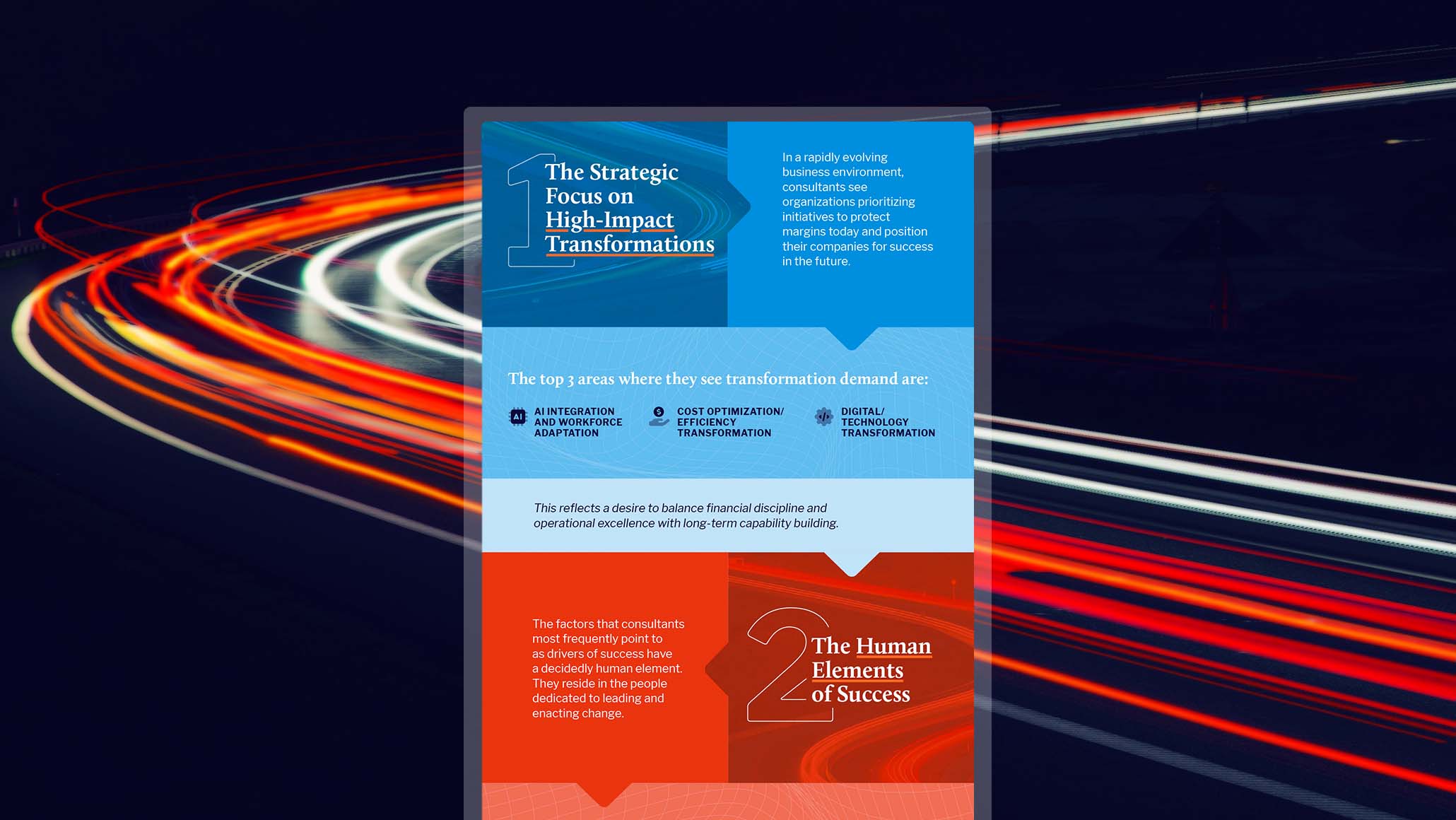
Transformation rarely fails because the strategy is wrong. It fails because execution isn’t systematized. As consultants, this is something we see frequently. In fact, in Catalant’s recent transformation report, 88.7% of consultants agreed that execution gaps are more likely to be reasons for transformation failure than strategy gaps. This implies a fundamental flaw in the way businesses enact change.
When companies treat transformation as a finite initiative — a siloed program with a defined start and end date — they undermine their own ambitions. The most successful enterprises do not “run transformation projects.” They build institutional capabilities that produce repeatable progress. And the data suggests that, within the next few years, organizations are likely to view transformation as a continuous evolution.
Decision latency is another complicating factor. In most organizations, decisions that should take hours take weeks — lost in handoffs, forums, and exceptions. The result is predictable: teams stay busy, plans get updated, and value arrives late or never.
Meanwhile, AI raises the stakes. It compresses the half-life of information and increases the pace at which leaders must commit resources and make trade-offs. Firms that can’t execute on these decisions coherently will drown in insight while their competitors move forward.
Transformation, then, should not be treated as a program. It should be approached as an operating system upgrade that reduces decision latency, hardwires value realization, and builds closed-loop learning into how a business runs. In this article, we’ll explore the elements required for successful transformation, review the benefits of the operating system approach, and dig deeper into how companies can make the tactical and cultural leap to this methodology.
The “what” of transformation: Restructuring for change
The transformation operating system
First, let’s unpack the elements required for real transformation. This is the “what” — the structure that supports a company’s new process.
Successful transformations build an execution operating system—a management layer that sustains the routines, decision rights, and discipline needed to keep performance improving. Here, we refer to that layer as the Transformation Operating System (TOS).
A TOS is not a rebranded project management office (PMO). It is not merely a governance overlay. It is an execution architecture that translates strategy into measurable performance — continuously.
Planning remains important, but it is not the engine. Instead, it functions as an embedded utility within a dynamic four-step cycle:
- Sense: Explore customer insight and frontline feedback to identify friction and pain points ripe for renovation.
- Decide: Prioritize interventions based on financial impact, strategic relevance, dependencies, and speed to value.
- Act: Make pragmatic and cultural changes to address the issue.
- Learn: Measure outcomes, validate hypotheses, and feed insights into the next cycle.
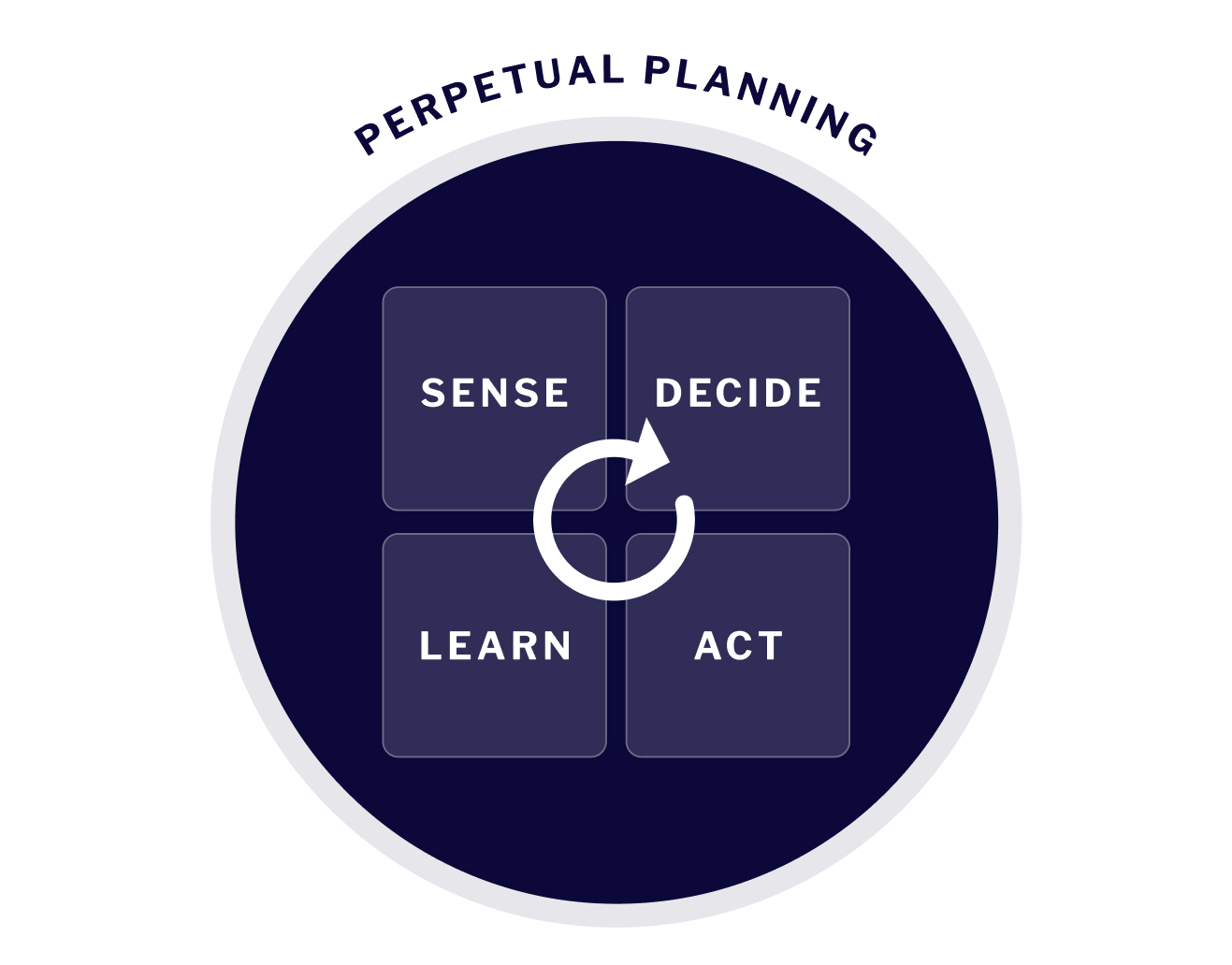
This is not a linear sequence. It is a continuous loop. Planning supports the loop; it does not drive it.
The redefined transformation office
A TOS includes a redefined transformation office as its foundation. This is not another department with reporting responsibilities but an enterprise nerve center.
The transformation office maintains integrated visibility across initiatives, value themes, interdependencies, and risks. It surfaces bottlenecks early and enables cross-functional coordination before friction escalates into delay.
Critically, planning resides here — but planning must evolve. Here, documentation must go beyond flat Gantt charts, integrating holistic factors into dependency-based roadmaps. Project resourcing needs to be capacity-aware. Everything from subject matter expert (SME) access to IT release constraints can push a project off track if not taken into account.
For example, picture an organization going through a pricing transformation. Many pricing initiatives fail not because strategy is flawed but because prerequisite gates were invisible: standards for master data updates, discount approval redesign, ERP configuration changes, and compliance controls were never explicitly set. The transformation office ensures such dependencies are visible, assessed, and gated before value assumptions are made.
With a central office designed to lead process and ensure transparency, sequencing becomes a strategic lever rather than an administrative afterthought.
Five domains of change
The TOS orchestrates change across five domains — the what.
People
Transformation is behavioral before it is operational, yet organizations consistently underestimate the cultural aspects of transformation. The TOS can help by aligning employee incentives to outcomes to foster capability shifts and evolve leadership behavior. Coaching loops and economic reinforcement promote adoption more effectively than a communication campaign alone. Supervisors should be measured on their daily management routines and adoption metrics, not attendance.
Process
The TOS can help redesign a company’s end-to-end value stream, developing standard processes, establishing central controls, and reducing handoffs. A redesigned order-to-cash flow with clear SLAs and ownership reduces disputes and improves days sales outstanding (DSOs).
A pitfall organizations may face is the temptation to digitize systems that do not serve their active needs. Organizations must resist digitizing broken processes, instead rethinking the process to first make it effective. Accelerating an underperforming system only leads to a faster accumulation of issues.
Technology
When it is time to update technology, the TOS can implement new systems to improve workflow. Solid data foundations are especially non-negotiable for transformation. Teams should give first consideration to master data integrity, integration, and governance. In practice, a warehouse scanning solution only scales once picking processes are simplified and accuracy is stable. Companies that provide a secure technological foundation create space for rapid evolution.
Customer experience
A company’s customer base is a powerful external motivator. A customer-centric design process anchors transformation as businesses seek to reduce friction. For instance, consumer-facing pledges like a promise to “receive a quote in 24 hours” force workflow redesign, approval automation, staffing models, and prioritization rules. Efficiency programs without customer anchors drift inward as companies lose sight of their end goal. Customer feedback and influence identify new opportunities to keep businesses proactive.
Operating model
Checklist: Critical enablers
Four foundational capabilities reinforce the TOS:
- Change management as an adoption engine
Role-based training, reinforcement loops, stakeholder mapping, and adoption KPIs make change behavioral — not merely communicational. - Analytics as closed-loop control
A KPI hierarchy connecting outcomes to drivers enables anomaly detection and scenario steering. Leaders operate from a control-tower perspective. - Governance embedded in workflows
Approval thresholds, audit trails, and exception rules reduce friction while preserving control. - Talent and incentives
Compensation structures and performance reviews reinforce adherence to the new operating rhythm.
The “how” of transformation: Focus areas
The TOS reshapes operations at two levels: structural (“hardware”) and behavioral (“software”). The following are areas that a company’s TOS can focus on to power transformation.
Developing a cadence that drives accountability
Execution architecture matters as much as strategy itself. Without disciplined cadence, even well-designed transformations stall.
A strong operating rhythm collapses decision latency. Unresolved blockers can be escalated and resolved within 48 hours, leaving momentum intact.
An effective cadence typically includes:
- Weekly execution reviews to surface blockers and track leading indicators
- Biweekly or monthly steering forums for material trade-off decisions
- Monthly value resets to recalibrate benefit forecasts
- Quarterly baseline updates to reinforce financial discipline
Decisions to scale, pause, or resequence are treated as formal milestones, not informal side conversations.
This structure eliminates meeting sprawl and shortens learning loops. It enforces rolling-wave commitments: the next 4–8 weeks are planned in detail, while subsequent quarters are defined by themes and gates rather than artificial precision.
False certainty is replaced by informed adaptability.
Committing to finance-grade value realization
Value realization can be another tension point for transformation efforts. Using value discipline as a framework can help communicate the economic benefits of transformations by treating outcomes like financial assets rather than narratives. Companies can choose to excel in one of three areas: operational excellence, product leadership, or customer intimacy, while maintaining standards across all three. This focus allows firms to differentiate themselves, align organizational efforts, and achieve market leadership.
Value discipline does, however, require a high level of specificity to reach the trustworthiness of finance-grade reporting. Companies should define:
- Clear baselines
- Explicit value hypotheses
- Named benefit owners
- Defined timing assumptions
- Confidence levels
- Formal finance sign-off rules
Tie value to KPI movement or leading indicators — never to task completion. Initiatives do not “close” until value is realized and sustained. Procurement savings, for example, are not counted when negotiations finish. They are counted when contract rates appear on invoices, ERP conditions are updated, and compliance is verified.
With this approach, leakage from adoption gaps, control weaknesses, or data issues can be treated like a defect to eliminate, not an unfortunate surprise.
Accelerating decision velocity and escalation
Transformation speed is a function of decision speed.
A TOS assists by establishing clear decision rights, documented thresholds, and service-level agreements (SLAs) for escalation. The TOS defines trade-off language in terms of value, risk, timing, customer impact, and feasibility, while maintaining a formal decision log. This rapid dependency planning creates a queue of decisions that the TOS can resolve during normal operating cadence.
For example, clearly-defined discount authority tiers with a 24-hour SLA for exceptions can materially protect margin. Without that clarity, decisions stall and erosion occurs in approval limbo.
Decision architecture is not bureaucracy. It is acceleration.
Creating a single-source-of-truth infrastructure
Lack of executive alignment is a common cause of transformation failure. One key way to ensure alignment is by maintaining a single source of truth. A TOS can enforce an effective, unified artifact structure:
- One integrated enterprise plan
- One KPI tree and dashboard
- One RAID log
- One decision log
- One benefits tracker
This single source enables exception-based management. It reduces debate and surfaces contradictions early. These artifacts are not static documents. They function as a connected system that links initiatives to value, dependencies, decisions, and risk—and feeds the Sense–Decide–Act–Learn loop with consistent inputs
Avoiding execution theater
Even well-intentioned transformations can drift into “execution theater” — activity without impact.
Warning signs include:
- Metric drift: Status indicators replace measurable KPI movement
- Ownership drift: Initiative owners remain, but benefit owners disappear
- Governance drift: Forums become reporting sessions rather than decision sessions
- Precision illusion: Long-range detailed plans create false certainty and incentivize date optimization over outcomes
A simple principle corrects this drift:
The engines of transformation are value discipline, decision velocity, and adoption — reinforced through cadence and artifacts. Planning, by contrast, is simply a throttle. If the dashboard is green and the P&L is flat, you’re watching theater.
Forward to an institutional capability
Transformation is a consuming ambition. It rarely succeeds through isolated fixes; but requires a coordinated system across the enterprise. That also means that transformation requires new, holistic skills. Internal capabilities may need to be guided or augmented throughout the process.
Transformation itself will also transform, given a long enough timeline. AI will empower the next-generation TOS to operate in real-time. It will take less time to sense problems, resulting in earlier detection of leakage and operational anomalies. Shorter transformation loops and faster scenario simulation will allow more dynamic resource allocation.
But the strength of AI will remain its biggest weakness: AI amplifies the operating system it works within. If the human aspect of a company’s transformation is not aligned, AI augmentation will not help. If decision rights are unclear, cadence is weak, and value discipline is absent, more data does not create clarity — it introduces confusion.
The ultimate objective of a transformation operating system remains, then, not to complete initiatives but to assist decision-makers with a repeatable capability, creating an enterprise that can continuously sense, decide, act, and learn with clarity. Organizations that install this operating system do not merely execute change. They institutionalize adaptability — and make innovation routine.
Ready to take the next steps in your business transformation?
Reach outMeet the Author
Vaibhaw Raghubanshi is a Catalant consultant and hands-on transformation and value creation leader who partners with CEOs, PE Operating Partners, and enterprise executives to accelerate growth, unlock cash, and institutionalize performance discipline. A former McKinsey Engagement Manager, Vaibhaw is trusted by PE sponsors and Fortune 1000 operators to translate strategy into measurable, sustainable results. He has more than 18 years of experience leading transformations across leading organizations, spanning manufacturing, services, and industrial technology.