











The Modern Enterprise Growth Engine: A Leader’s Guide to the Next Wave of Value


Until recently, the corporate playbook was predictable: streamline operations, refine portfolios, and scale established models through incremental gains. That cycle has ended, and today, a more volatile growth environment is taking hold. This new landscape is defined by fragmented consumer demand, the rapid integration of AI, and persistent macroeconomic shifts.
Many mid-market organizations now face a unique strategic bottleneck: they have outgrown the agility of a startup but lack the infinite balance sheets of a global conglomerate. They are trapped in the mid-market paradox: too large to be nimble, yet too resource-constrained to hedge every bet. The leaders who break through this ceiling aren’t those who double down on legacy tactics; they are the ones who build disciplined systems to identify and accelerate their strongest opportunities.
In this next chapter, value is being captured by organizations capable of three distinct capabilities:
- Sensing context: Rapidly identifying shifts in market and consumer behavior
- Designing new models: Creating novel monetization and delivery models
- Executing at scale: Building a repeatable engine that converts raw insight into enterprise-wide action
The winners of this era won’t succeed by pulling the traditional levers harder. They will win by embracing an adaptive, insight-led strategy centered on constant renewal and a relentless focus on evolving customer value.
The erosion of the traditional growth playbook
The mechanisms of value creation are being fundamentally rewritten by converging market pressures:
Contextual fragmentation and shifting unit economics
The modern market is no longer a monolith. We are seeing a divergence in purchasing power where high-end segments demand premium experiences, while others are aggressively trading down. This isn’t just a budget shift; it’s a shift in context. Reacquiring or retaining customers now requires meeting them in specific moments of need, where legacy products or outdated go-to-market strategies no longer land.
The implication: Growth now belongs to those who can map their offerings to specific, targeted customer journeys rather than mass-market averages.
AI as a catalyst for asymmetric competition
Artificial intelligence and advanced analytics are no longer just efficiency tools — they are re-engineering the entire value chain. From predictive demand sensing to automated decision-making, AI allows lean competitors to bypass the traditional scale advantages of established enterprises.
The implication: Speed, precision, and relevance have become table stakes, and the organizations that thrive will be those innovating to create novel workflows and experiences.
Heightened risk and the rising cost of capital
In a climate defined by margin compression, supply chain volatility, geopolitical friction, and other environmental challenges, the penalty for a failed strategic bet has never been higher. With consumer sentiment hitting decade-level lows, leadership teams are understandably moving away from growth at any cost.
The implication: The focus has shifted from high-volume experimentation to high-conviction deployment of capital.
Ultimately, these forces are siphoning value away from rigid incumbents and toward agile platforms and ecosystems that can pivot at the speed of the market.
Five levers for modern enterprise growth
Value is no longer found in traditional expansion; it is being generated at the intersection of evolving human needs and adaptive operating models. These five catalysts are driving today’s high-growth organizations:
1. Contextual re-segmentation
Modern growth is increasingly found by moving beyond static demographic profiles and instead solving for the specific jobs-to-be-done within a customer’s shifting environment. This requires a transition from knowing who a customer is to understanding the precise context — the “when” and “why” — behind their decisions.
Olipop and Poppi disrupted the stagnant beverage category. They didn’t just launch a new soda; they identified an unmet need for functional, low-sugar wellness in moments where consumers previously had no healthy alternative.
To win in this landscape, leaders must evaluate whether their current segments are defined by historical data or by the specific problems their customers are trying to solve today.
2. Customer equity maximization
For many enterprise organizations, the most efficient engine for high-margin growth already exists within their current relationships. Existing customers offer a level of trust and data richness that makes them far more valuable than any new acquisition. By shifting the focus from simple retention to deepening the total value delivered to their core base, companies can transform loyalty into a primary growth lever.
LEGO provides a masterclass in this approach. By re-engaging its adult fan community and expanding into co-creation platforms and digital and in-person experiences, the company tripled its revenue over a decade.
This raises a critical strategic question: do you currently invest more in reaching strangers than you do in maximizing the potential of your most loyal customers?
3. Revenue stream diversification
The most resilient companies are those currently building high-margin services around their core products, moving from linear sales to subscription, usage-based, or data-driven models. They are also capturing opportunities to monetize data or insights or enter new categories that integrate well with their core business. Innovation is no longer just about adding features; it is about creating entirely new revenue streams that monetize the edges of the existing business.
Uber effectively executed this by leveraging its logistics infrastructure to launch Uber Eats, Uber Direct, and Uber Freight — ancillary businesses that complement their core model. Now, delivery and freight represent nearly half of the company’s total bookings.
If the vast majority of your revenue still comes from offerings that existed five years ago, your innovation strategy may be more incremental than the current market demands.
4. New channels and distribution models
Distribution is no longer just a logistical “route to market”; it is a strategic engine for discovery and relevance. Forward-thinking organizations are bypassing traditional channels to meet consumers in unconventional digital spaces — utilizing creator ecosystems, social commerce, and community-led platforms to foster discovery and engagement, as well as conversion.
e.l.f. Beauty achieved exponential growth by moving “at the speed of culture,” ditching the legacy beauty playbook to become a digital-first powerhouse on platforms like TikTok.
In an era where challengers can appear overnight, leaders must identify which emerging channels a well-funded competitor would use to bypass their established distribution networks.
5. Business model evolution
The final frontier of modern growth lies in evolving from a rigid, linear value chain into a flexible, tech-powered ecosystem. The winners of this era are organizations that can flex their business models as economic conditions and customer needs shift, often moving into high-margin spaces like advertising or marketplaces.
Walmart’s evolution from a brick-and-mortar retailer into an omnichannel platform — powered by Walmart Connect and Walmart+ — shows how a legacy giant can build durable, diversified revenue streams.
Ultimately, you must determine if your business model is optimized for a set of market conditions that may no longer exist or if it is built to adapt as the landscape continues to shift.
However, identifying these levers is only half the battle. Pulling them requires overcoming deep-seated organizational inertia.
Obstacles to scalable growth
While the opportunity for expansion is clear, the gap between identifying growth and capturing it remains wide. For most enterprises, the barriers are structural and behavioral rather than strategic. These five failure modes explain why growth often stalls:
- Insight lag: Organizations often suffer from an insight lag, where teams learn too slowly or too shallowly. Without a deep understanding of the shifting contexts in which customers operate, strategies are built on a foundation of outdated assumptions.
- Aperture lock: This occurs when leadership prematurely rules out new opportunities. By focusing exclusively on today’s business, they fail to see — or seize — the broader addressable market that disruptors are already colonizing.
- Activation gap: Promising ideas often die between strategy and execution. Companies become paralyzed by analysis, spending too much time on decks and not enough on the pilots and experiments required to gather real-world evidence.
- Decision fog: Even when data is abundant, growth is stifled by a lack of clear ownership. When it isn’t clear who has the authority to act on an insight and make decisions, the organization remains stuck in a holding pattern.
- Operating model drag: Most enterprises are structurally optimized to defend the last wave of growth, not the next. When the company’s internal structures are all calibrated for the status quo, the organization’s internal systems will actively reject the behaviors required for innovation.
Ultimately, most companies do not lack ideas. But they often need to build the mechanisms, culture, and cross-functional alignment required to turn those ideas into realities and scale them.
How to ignite the enterprise growth engine
To capture the next wave of value, leaders must shift from episodic innovation projects to a repeatable enterprise growth engine.
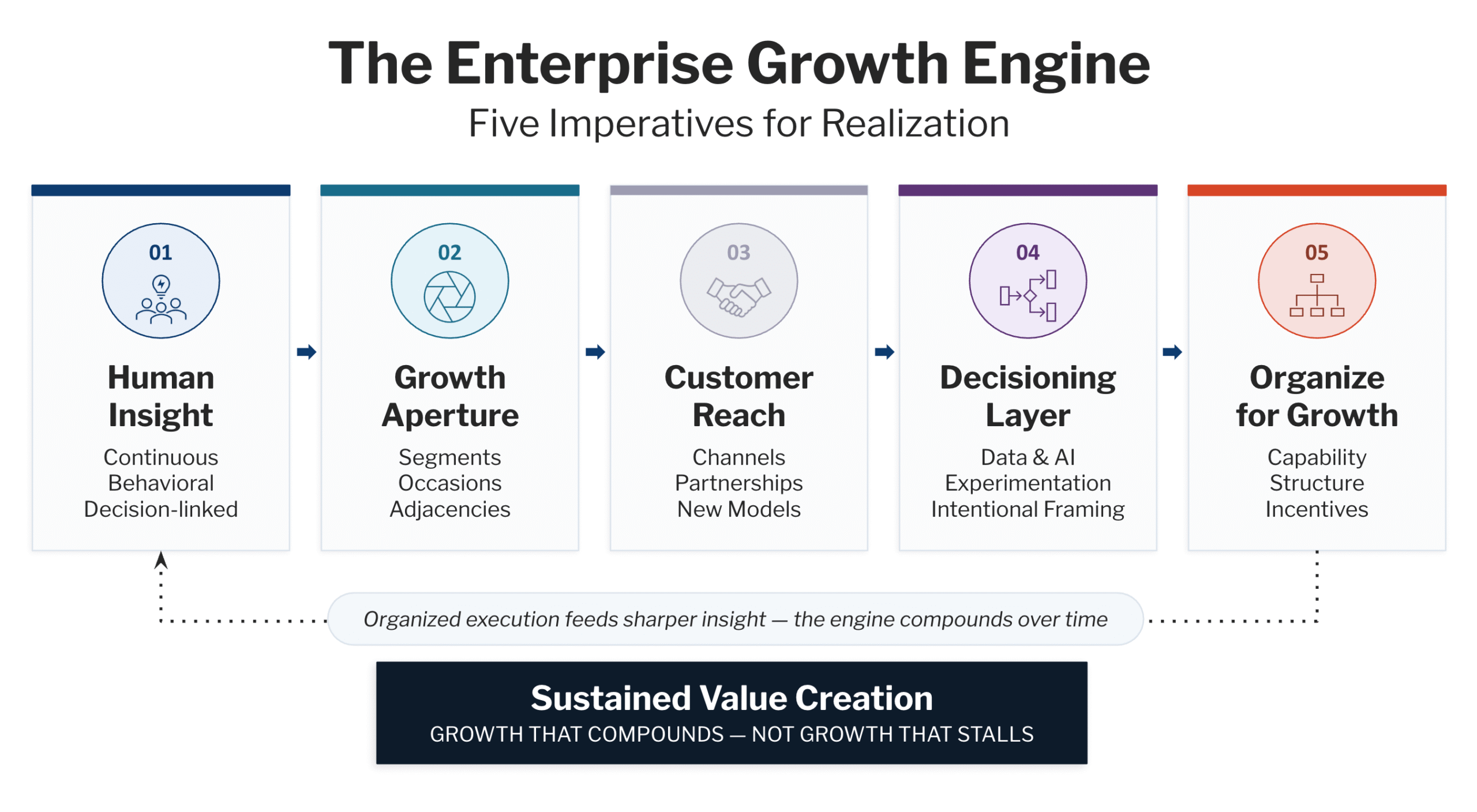
This is a systemic approach to identifying, validating, and scaling high-conviction bets through five strategic imperatives:
1. Human insight
Insight only has value when it accelerates a decision. The engine begins with a deep understanding of the jobs-to-be-done and the specific frictions customers face. Rather than relying on static attitudinal surveys, forward-leaning organizations invest in behavioral analytics and use AI to detect emerging micro-trends and shifts in sentiment. Growth occurs when a company can perceive market changes and customer needs faster and more clearly than its competitors.
2. Growth aperture
Leaders must replace periodic passion projects with disciplined planning that prioritizes growth across multiple horizons. This involves expanding the lens beyond the core business to include new customer contexts, adjacent service categories, and emerging value pools like data-driven ecosystems. This mindset shift replaces incrementalism with a portfolio of bold, future-forward bets.
3. Customer reach
Winning in a fragmented market requires reinventing how the organization reaches its audience. This means testing new channels and platforms, leveraging AI for hyper-personalization, adopting new growth and service models, and treating strategic partnerships as a source of competitive advantage rather than just a sales channel. When distribution and access are treated as strategic levers, they unlock entirely new avenues for scale.
4. Decisioning layer
Most enterprises don’t have a data problem; they have a decision problem. Growth requires the discipline to treat AI and data as force multipliers rather than standalone strategies. This involves creating experimentation platforms for rapid testing, utilizing AI-enhanced forecasting, and ensuring that unified data is actually enabling precision targeting and revenue management. In an AI-driven world, what you choose to do becomes more critical than how you execute.
5. Organize for growth
Sustained expansion is an enterprise-wide capability, not a departmental function. It requires dismantling silos to ensure data and talent flow freely across the organization. Leaders must align on decision rights, establish clear ownership and accountability for growth priorities, and calibrate KPIs and incentives toward long-term value creation. Whether building, partnering, or acquiring, the goal is a unified growth narrative that cuts across the entire P&L.
The executive checklist: Immediate next steps
Transitioning to this model doesn’t require perfect conditions, but it does require a bias for action. To begin building your growth engine today:
- Audit the shifts: Pinpoint the three primary market forces currently redefining how your customers make decisions.
- Craft and test your thesis: Identify which growth opportunities are being ignored or left to competitors. Then, select your high-growth bets and accelerators.
- Build a growth foundation: Construct the systems and workflows needed to support the data, decisions, governance, and incentives growth requires.
- Deploy high-velocity pilots: Launch small-scale experiments in new channels or partnerships to gather real-world evidence.
- Align the incentives: Ensure your KPIs and talent strategy are focused on value creation rather than mere output or activity.
Leadership methods to support future growth
Realizing the next wave of growth is a fundamental commitment to the future. Success in this new era belongs to leaders who are willing to challenge assumptions, embrace a new customer mindset, and rewire organizations for continuous evolution.
The companies that accelerate from this point will win by institutionalizing the capability to sense market shifts, decide with high conviction, and act with a velocity that competitors cannot match. This transformation requires more than just new tools — it demands:
- Decisive leadership: Charting a clear strategic course while maintaining the fortitude to hold the organization accountable to that vision
- Architectural agility: Transitioning to an operating model designed to flex, experiment, and scale in real-time
- An insight-led culture: Fostering a mindset of perpetual adaptation rooted in a deep, empathetic understanding of the customer’s evolving world
The opportunity for market redistribution is extraordinary. However, building an enterprise growth engine while simultaneously managing the core business is a significant undertaking. Often, the fastest path to transformation isn’t found by looking inward, but by leveraging external experts who have orchestrated these shifts before. These specialists bring more than just a fresh perspective; they bring the experience required to bypass common failure modes and accelerate execution.
Ready to build your growth engine?
Get in touchMeet the Authors
Nick Cox is a Catalant Consultant and the Founder and CEO of HighRidge Strategy, a boutique consulting firm that partners with executives to turn uncertainty into confident, capital-efficient growth — through strategic clarity and operational effectiveness. As a growth strategy and operations leader, Nick brings deep experience as a consultant and operator across consumer goods, industrials, life sciences, and private equity. He holds a Master of Business Administration from the Duke University Fuqua School of Business and a Bachelor of Engineering in Industrial and Systems Engineering from Auburn University.
Jon Edwards is a Catalant Consultant and the Founder and CEO of Edwards Strategy Partners, a strategic advisory that empowers leaders to better navigate complexity and accelerate value. He has more than 20 years of experience helping global Fortune 500 and mid-market organizations define and activate transformational strategies that drive growth, innovation, and lasting impact, both as an independent consultant and through leadership roles at Accenture. Jon holds a Master of Business Administration from the Tuck School of Business at Dartmouth College and a Bachelor of Arts in Economics from Amherst College.