











Retail Companies: Strategic Priorities for 2026


The retail sector exited 2025 facing a stark valuation gap. While a handful of resilient brands captured significant growth, the broader industry lagged, with the S&P Retail Index trailing the S&P 500 by 9.4% in 2025. This delta signals a clear message from the capital markets: investor skepticism is mounting against traditional retail models that lack clear, high-growth trajectories.
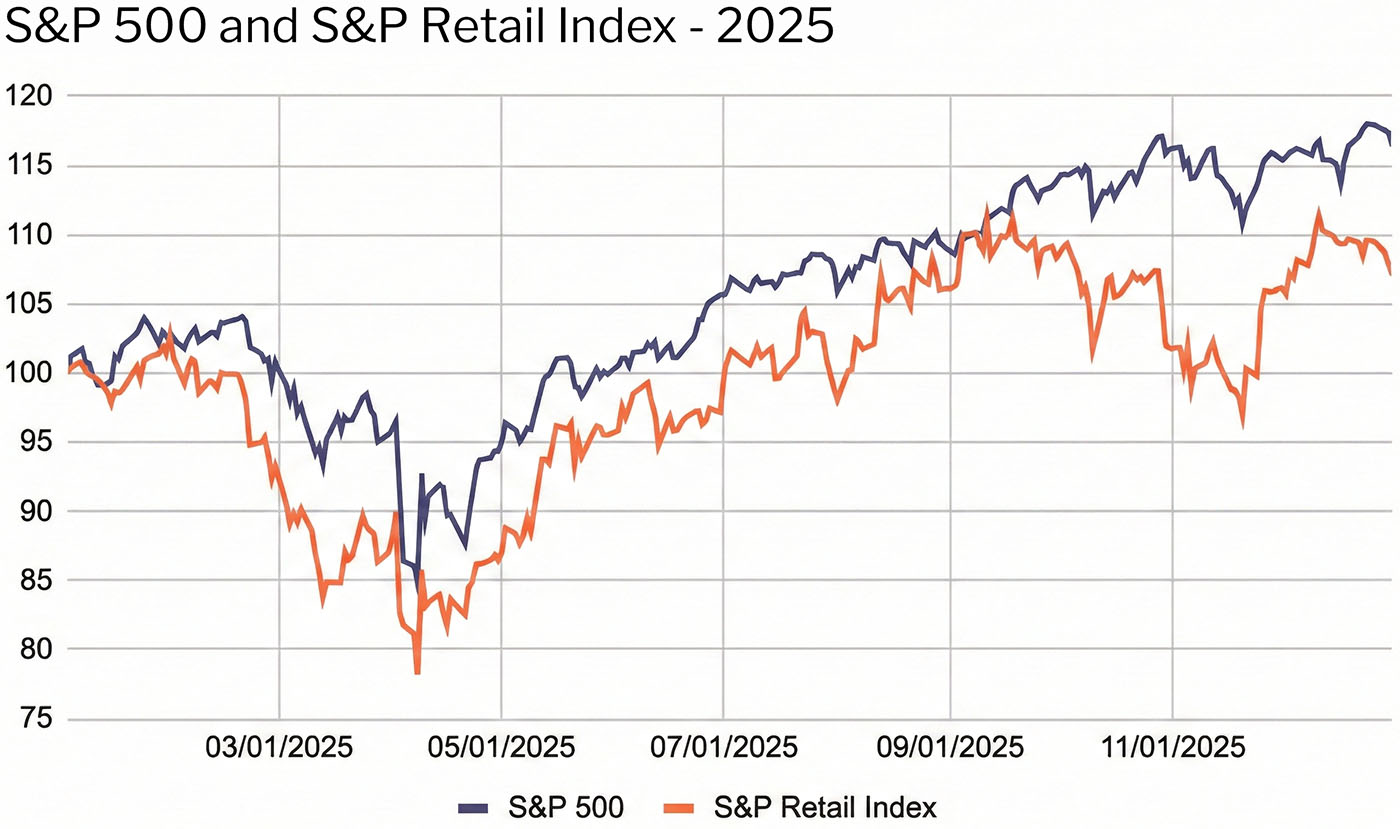
Source: Investing.com
The headwinds are increasingly complex, pressing on retailers from multiple angles. Continued inflation has compressed margins due to elevated sourcing and logistics costs, while cautious consumer spending habits — especially among middle-income consumers — have capped organic growth. Compounding these issues is a visible stagnation in volume; much of the sector’s recent revenue gains have been propped up by pricing levers and portfolio optimization rather than genuine demand expansion. This reliance on price over volume is a trend that capital markets view as inherently unsustainable.
For retail leaders, 2026 is not a year for incrementalism. It is a year for high-stakes discipline. Success will require moving beyond trend chasing to focus closely on the fundamental pillars of durable value creation. The following priorities outline the strategic approaches for success in this increasingly complex landscape in 2026 and beyond.
1. Accelerate AI adoption and tech integration
AI is shifting from experimentation to core infrastructure, particularly in areas such as inventory management, pricing optimization, and personalization.
Retailers are transitioning from “search-based” retail to “agentic” retail. The strategic challenge is no longer just being discoverable by humans but being discoverable by AI agents. This requires a shift to generative engine optimization (GEO), which is replacing traditional SEO. Retailers must restructure product catalogs so that generative AI models recommend them during the research phase of a customer journey. However, this doesn’t come without challenges, such as data quality, integration, ethical concerns around transparency and privacy, and skills shortages.
This shift requires retailers to build machine-to-machine transaction capabilities. As consumers increasingly use AI assistants to find the “best deal,” retailers must race to build infrastructure for agent-executed transactions, including integrated payment systems and fraud protection for non-human shoppers.
AI is not only reshaping the way retailers interact with consumers but also how they manage their back offices. Invisible AI engines are now playing an increasing role in almost every function, sometimes fully managing key processes. Leading retailers are building out and implementing use cases in sales, marketing, supply chain, HR, and finance.
2. Navigate evolving consumer value drivers
Retailers have to adjust to major consumer trends. Success in 2026 requires a calibrated response to three primary shifts in behavior as customers prioritize cost savings, quality, service, and ease of purchase.
- Value-seeking habitualization: For a large portion of the population, “trading down” is no longer a temporary reaction to inflation but a structural habit. Discount formats and membership clubs are seeing record growth. For example, Walmart’s stock rose over 25% in 2025, highlighting price discipline as a core consumer expectation.
- Hyperpersonalization: Meeting the consumer where and how they want to be served will be a critical pillar of success and driver of loyalty. However, this can be both technically and ethically complex to execute well, as retailers must balance high-tech execution with the ethical handling of consumer data to maintain brand trust.
- The experience economy: While the middle market seeks value, high-income consumers are prioritizing “moments over merchandise.” This has compelled premium retailers to transform physical stores into wellness and service hubs, incorporating fitness, healthcare, and immersive events to justify premium prices and drive foot traffic.
Successful retailers will align pricing, personalization, and omnichannel experiences with evolving consumer preferences, ensuring every touchpoint reinforces consumer trust.
3. Architect omnichannel and unified commerce
Omnichannel is now the baseline expectation, not a differentiator. The challenge for 2026 is unified commerce — the seamless integration of online, in-store, mobile, and pick-up experiences (including returns and fulfillment) — which remains difficult without the total dissolution of siloes between online and in-store data.
True fluidity requires a single view of inventory. Retailers must move toward accurate real-time inventory systems to provide frictionless experiences and support the high-stakes demands of same-day pickup and ship-from-store models, which risk eroding margins through out-of-stock cancellations.
Retailers must balance physical and digital investments and turn stores into both brand experiences and fulfillment hubs. Winning omnichannel execution requires tightening operational workflows and seamless data integration across systems.
4. Strengthen supply chain resilience and labor agility
Supply chains have moved from a back-office function to a core competitive advantage. As global trade maps are redrawn, retailers must manage three critical shifts:
- Operational agility: Retailers are navigating ongoing logistics issues, inventory visibility gaps, and labor shortages. The strategic response involves a mix of centralization, algorithmic planning, and localized micro-fulfillment to maintain speed and flexibility.
- Trade and tariff mitigation: Significant tariffs are forcing retailers to choose between absorbing costs and passing them on to customers. Strategies have shifted toward rapid near-shoring and diversifying suppliers to protect the bottom line.
- Circular commerce operations: Sustainability has moved from being a marketing tactic to an operational necessity. Retailers are scaling circular commerce models — resale racks, trade-in credits, and products designed for recycling — to mitigate raw material volatility and meet consumer demand for ethical consumption.
5. Protect margins amid global economic pressures
After years of prioritizing top-line growth, the focus has shifted to financial fortitude. Retailers are no longer pursuing growth at any cost, especially as years of inflation, rising operational costs, and geopolitical trade tensions — including tariffs impacting pricing and supply inflows— are pressuring margins. Retail stocks and earnings can be volatile amid these macro pressures.
To safeguard the bottom line, retailers are abandoning outdated practices in favor of better economic policies. First, the era of generous e-commerce return policies is over. Major global retailers are now implementing stricter guidelines, often using machine learning to offer favorable return terms only to their most profitable, high-margin customers.
Simultaneously, companies are increasing precision in pricing and assortment. By abandoning “one-size-fits-all” models in favor of dynamic pricing and hyper-local assortment strategies, retailers are reducing the need for broad markdowns.
In addition, retailers are renewing focus on private label authority. Private labels are no longer “budget” options; they are strategic loyalty levers. Retailers are using high-quality private brands to capture greater wallet share as shoppers now prefer them over name brands, allowing for better margin control.
6. Rationalize store footprints for strategic utility
Store closures will continue as major chains reconfigure brick-and-mortar footprints in favor of online growth and profitable locations.
The broader “retail apocalypse” trend of shrinking physical retail suggests stores must justify their cost through specific utility: as an experience center, a fulfillment hub, or a brand showroom. Every square foot is now measured against its contribution to the total omnichannel ecosystem, not just four-wall sales, and in some cases, a small-format retail footprint that prioritizes high-velocity essentials and digital pick-up over massive, underutilized floor space can demonstrate greater returns.
Furthermore, the role of the store associate is being redefined. As physical locations shift into multi-purpose hubs, the workforce is tasked with managing complex workflows and acting as brand ambassadors, turning physical stores into vital sources of high-value, first-party consumer data. The ultimate goal is a rationalized network where every store serves a clear purpose.
7. Scale retail media and data monetization
Retailers are increasingly becoming “media moguls,” recognizing that first-party data capturing actual purchase behavior is now possibly more valuable than the products themselves.
This shift is powered by the fact that retail media networks offer up higher margins than core grocery or apparel sales, providing a vital new revenue stream in an era of compressed product margins. Retailers can now leverage customer insights and media properties to diversify revenue far beyond the sale of physical goods.
The strategic challenge is one of balance: retailers must find ways to integrate advertising into the shopping experience without creating friction or “ad fatigue” that could alienate the core customer. Successfully capturing these high-value ad dollars while deepening customer relationships requires a foundational commitment to data infrastructure and privacy-forward analytics. By treating data as a primary asset, not just the byproduct of a sale, retailers can ensure that every ad served is a relevant addition to the customer journey rather than a digital distraction.
8. Uphold brand trust and ESG integrity
Consumers, retailers, and investors increasingly expect companies to demonstrate responsible growth. Meeting evolving regulatory requirements is non-negotiable, particularly in areas such as:
- Packaging and recycling mandates
- Ingredient transparency and labeling
- Emissions measurement and reporting
Leading companies go further, using ESG as a competitive advantage, not a compliance exercise. When executed authentically, ESG strengthens trust, improves retailer relationships, and enhances long-term shareholder value. Consumer trust — influenced by privacy, ethical AI, safety, and corporate social responsibility — is increasingly a competitive factor.
Public controversies or policy decisions (e.g., about DEI, immigration, or labor practices) can affect brand perception and sales, and retailers and employees must be cautious about taking brand risks. With the power of social media, one small misstep can erode millions, or even billions, of dollars in valuation.
Retailers must proactively build transparent, ethical practices that align with consumer values.
Converting market headwinds into competitive advantage
The performance gap seen across the sector in 2025 was a signal of a permanent shift in retail’s operating model. As we move through 2026, that delta between market leaders and the broader index will be defined by execution velocity. Success hinges on moving from a reactive posture to a proactive, data-led strategy that integrates AI, protects unit economics, and rethinks how physical footprints impact business operations and customer experiences. The retailers that stand out will wield the strategic levers we’ve discussed to drive new competitive advantages, moving beyond survival in this turbulent market and taking steps that the capital markets are eager to reward.
Ready to accelerate your 2026 strategy?
Connect with our teamMeet the Author
Gregg Clark is Managing Director, Consumer at Catalant, leading the company’s consumer business and bringing the value of Consulting 2.0 to consumer and retail companies. He also acts as faculty for the Institute for Mergers, Acquisitions and Alliances, a global not-for-profit M&A think tank and educational provider. Prior to joining Catalant, Gregg held senior management positions leading consumer strategy at EY, Accenture, and Capgemini, and he led Serenity Strategy, an independent consulting firm supporting leading enterprises through business strategy, digital transformation, advanced analytics, and M&A strategy and execution, for nearly 10 years. Gregg holds a Bachelor of Science in Electrical Engineering/Industrial Management from Purdue University.