
SECTION 1
Why A Strong Profile Matters
A good profile is like a good resume: it helps you get in the door.
You won’t win a project on your profile alone, but you can be eliminated from consideration if it misses the mark. Your profile’s job is to land you the interview. That’s where you show what you can do.
The most important thing to remember is: Clients don’t care about your accomplishments for their own sake—they care about how your experience can help solve their specific challenges.
Your profile is a chance to demonstrate that. Clients care most about how well you can help them solve their specific problem.
Your goal is for clients to read your profile and think: “This consultant can absolutely help me right now.”
Not: “This consultant is very accomplished.”
Let’s now talk about all the components of a strong Catalant profile.
SECTION 2
Key Components of a Strong Profile
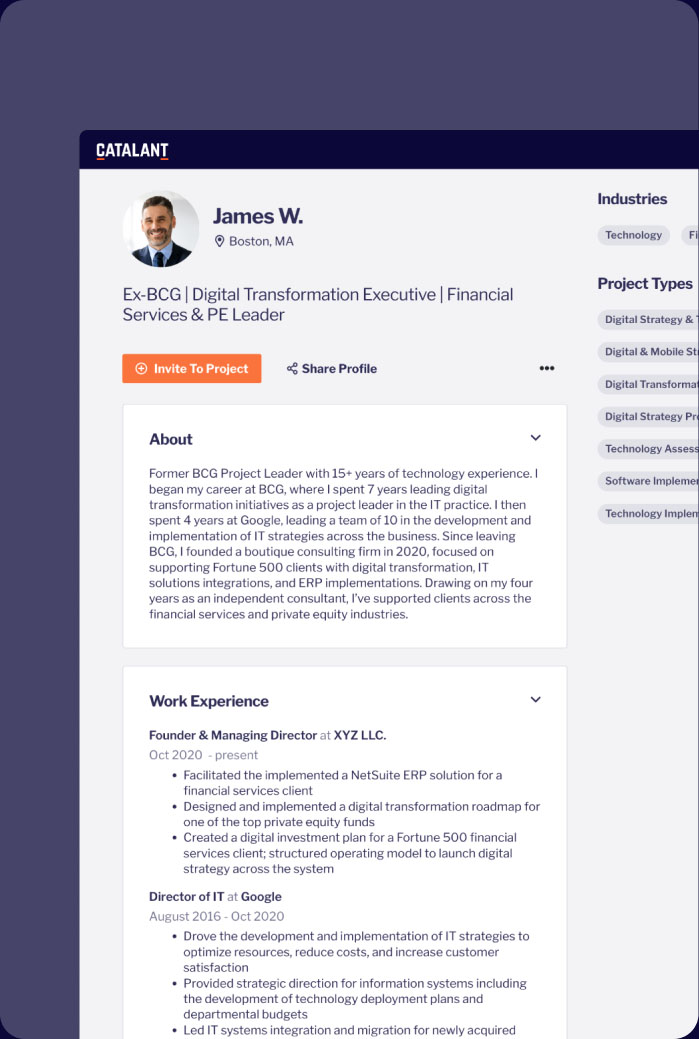
1) Photo
This one is self-explanatory. Upload a professional photo of yourself. This builds trust and approachability right away. Profiles that lack a photo often get tossed to the side or overlooked as clients are glancing through profiles.
Recommended

Not Recommended

2) Tagline
The tagline is critical, as it’s often the first thing a client sees. Catalant clients tend to be senior buyers with very little time. They’ll often scan through tag lines as a determinator of whether it’s worth continuing to review your profile. You want to craft something that is going to catch their attention and draw them in.
Many consultants default to listing passive credentials or vague experience. For example:
- “15 Years Consulting Experience”
- “Top-Rated Catalant Consultant”
- “Marketing Specialist”
Remember: Clients care about how your experience can help solve their specific challenges. Frame your experience in terms of value to them.
Stronger examples:
- “Specialist in Pre-Acquisition PE Diligence”
- “Ex-Fortune 500 Pharma Operator and Pricing Expert at Deloitte & Novartis”
- “Industrial Goods Supply Chain Optimization Expert”
Each one instantly communicates both key experiences and, importantly, how the consultant can help. For a client who desperately needs pharma pricing expertise, the second consultant example above is well-positioned to land an interview.
3) Work Preferences
This section asks about your availability, willingness to travel, and rate expectations.
A common concern: “Won’t clients just pick the cheapest consultant?” No. This section is not visible to clients—it’s for Catalant’s internal team to help match you to the right projects.
So, be honest with your rates and willingness to travel. For example, the author of this piece has always listed 0% travel availability, and it’s never been an issue with landing client work.
While the clients won’t see pricing at this stage (remember, this section of your Catalant profile isn’t visible to clients), you will eventually put together a proposal. Clients, right or wrong, use pricing as a proxy for quality. Bidding low can actually work against you to win work. For that reason, start working to reframe your pricing now by setting your daily rates higher than you would expect.
Pro Tip: Many first-time consultants underprice themselves, thinking it will help them land early projects. Don’t fall into that trap. Clients often use pricing as a proxy for quality—so underpricing can actually backfire. Start positioning yourself appropriately from day one.
4) About Me
This is your chance to tell your story—but do it from the client’s point of view. This section should highlight your work experience, project & industry expertise, and general interests. Following your tagline, this is the first thing clients will read when reviewing your profile. Profiles that lack a strong “About” tend to get passed over. Therefore, you should spend some time crafting this section, given it’s one of the first—and occasionally only—things a client might read before deciding to move forward with you or not.
Here’s an example of what not to do:
“Bob is an independent consultant with 15 years of consulting experience and nearly 20 years of professional experience. He spent 10 years at McKinsey, then joined Google’s business development team before launching his independent consulting career.”
It’s all about Bob—and that’s the problem.
Here’s a stronger version of the same background:
“Sue specializes in Private Equity value creation work, typically during the first six months post-acquisition. She works in two main ways:
1) Partnering with Chief Transformation Officers to lead or support the TMO and accelerate value realization across industries, typically for companies with $1–5B in enterprise value.
2) Working directly with PE value creation teams to lead operational improvements such as workforce and location consolidations, ERP implementations, and software rationalization.
Sue brings this experience from her time at McKinsey and Google, as well as from independent work with mid-market PE portfolios.”
Same resumes—completely different impact. The second version puts the client at the center and makes it obvious how Sue adds value for clients.
Pro Tip: This point cannot be over-emphasized: It should be extremely clear how you add value to a company and a specific client. Describe your work in a way that helps clients see themselves in your story. To do this well, highlight client types, industries, company sizes, and the stakeholders you typically partner with.
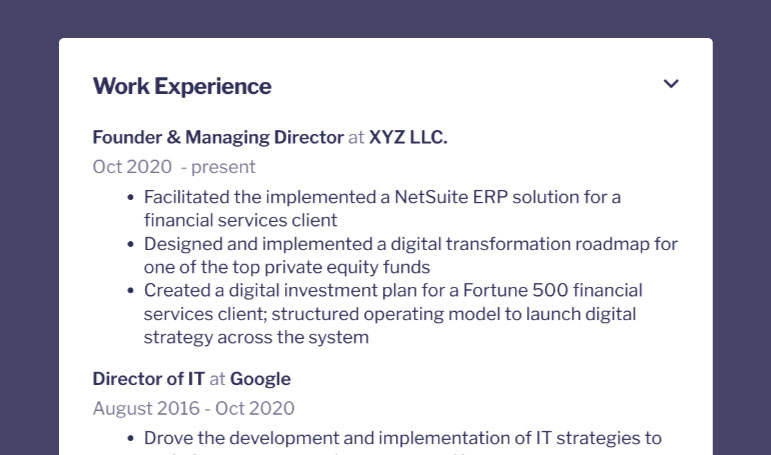
5) Work Experience & Education
This one’s straightforward: list your past employers and educational achievements (schools, degrees, etc). This helps clients understand your background and credibility.
Your ‘Work Experience’ section should provide detail into your work history, including job descriptions and relevant achievements. Your Catalant profile tends to function similar to a resume, so be sure to include most, if not all, of your work history. Similarly, include detailed bullet points under each “Work Experience” to give prospective clients a sense for the work you were involved in. If you are more senior in your career, you can limit the details of earlier roles.
6) Past Projects
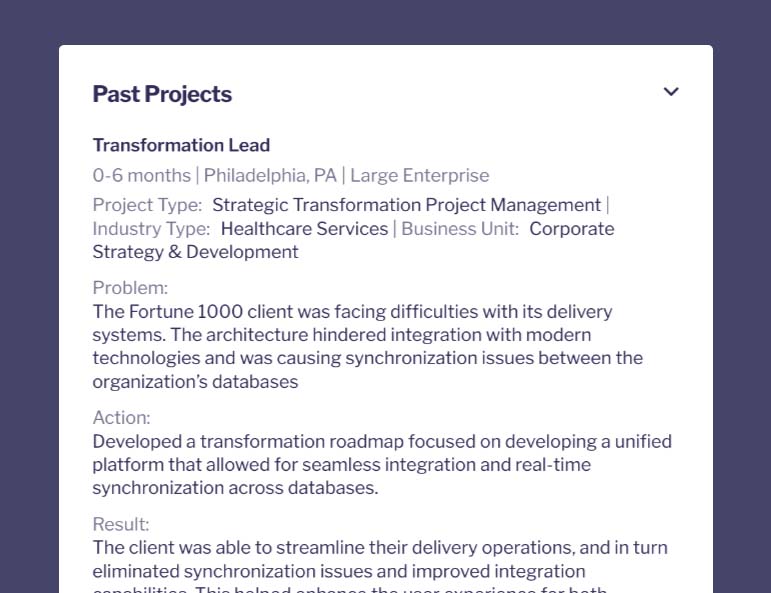
The number one factor clients consider when choosing an independent consultant is prior experience leading a similar project. As such, your ‘Past Project’ section helps bring this information front & center for a prospective client. These do not have to be projects completed on Catalant, you can include any relevant project experience from previous roles. Continuing the theme we’ve previously emphasized: focus on how you helped clients.
Catalant makes this easy by prompting you for key fields like project type, duration, and client industry, as well as framing the work as Problem / Action / Result.
Use the project summary to provide real detail—especially the client role that faced the challenge. This allows future clients in similar roles to immediately understand your impact.
Pro Tip: When you get to the pitch stage on Catalant, you’ll be able to highlight past projects in your pitch from a drop-down menu of projects you’ve listed on your profile. Clients report this being one of the top factors considered when evaluating candidates for the next stage. So make sure you include a least a few past projects you can pull from.
7) Ratings
If you’ve completed projects through Catalant, ratings from those clients will appear on your profile.
Strong ratings are a valuable form of third-party validation, but don’t worry if you don’t have any yet. New consultants land work on Catalant every day. Focus on what you can control: clear, compelling positioning.
8) Industries
This is your chance to call attention to the industries in which you have previous experience. Our clients often prioritize Experts who can demonstrate experience in a specific industry, so be sure to highlight the full breadth and depth of your industry expertise.
9) Project Types
This is your chance to call attention to the project categories in which you have previous experience. Our clients often prioritize Experts who can demonstrate experience leading similar projects, so be sure to highlight the full breadth and depth of your project expertise.
SECTION 3
Final Thoughts: Set Yourself Up for Success
Expect to spend 1–2 hours creating your profile. Start with a rough draft, then revisit it with fresh eyes. Most importantly, read it from the perspective of a client. Is it professional and complete? Does it clearly convey the value you bring? Would you want to work with you?
If you approach your profile with a client-centric mindset, you’ll dramatically increase your chances of landing the right projects.
Pro Tip: The best Catalant profiles are the ones that are up to date and reflect current capabilities, experiences, and incorporate trends as relevant. You should get in the habit of regularly updating your profile to make sure you get noticed for the right work.